The Art of Nurikabe: Unraveling the Logic Behind Japan’s Most Elegant Puzzle
Picture a serene island landscape emerging from a grid of numbers and empty cells. That’s the quiet thrill of Nurikabe, a Japanese logic puzzle that has quietly captivated minds around the world. Unlike the high-speed flash of digital games, Nurikabe rewards patience and methodical thought. It belongs to the same family as Sudoku and Kakuro, yet it possesses a unique visual and logical charm. Whether you’re a complete beginner or a seasoned puzzle enthusiast, understanding the world of Nurikabe—and how a well-designed puzzle book can elevate your experience—opens the door to hours of deeply satisfying mental exercise.
What Exactly Is a Nurikabe Puzzle?
The name Nurikabe translates from Japanese as “plaster wall” or “invisible wall,” which hints at the puzzle’s central concept. You’re given a grid, usually rectangular, filled with a scattering of numbers. Your goal is to decide which cells are part of a flowing “stream” (or island) and which are “walls” (the Nurikabe itself) that separate them. The rules are deceptively simple, yet the logical deduction required can be profoundly deep.
The puzzle was first popularized by the Japanese puzzle magazine Nikoli, which also introduced Sudoku to the world. Nurikabe made its first appearance in 1991 and has since built a dedicated following. Its appeal lies in the way it transforms abstract logic into a tangible, almost artistic composition. By the end of a successful solve, the grid reveals a connected body of water surrounding clearly defined islands, each island containing exactly one number that defines its size in cells.
The Core Rules: Simple Yet Profound
To truly appreciate any puzzle, you must know the ground rules. Nurikabe operates on four straightforward constraints:
- Island Size: Every number on the grid must be part of a single connected island made of white cells. That island must contain exactly the number of cells equal to the digit shown.
- One Number per Island: No island can contain more than one number. Each numbered cell is the “seed” of its own island.
- Wall Connectivity: All black cells (the wall) must be connected into a single, continuous shape. Diagonal connections do not count—walls must be linked vertically or horizontally.
- No Wall Pools: The wall cannot form a solid 2×2 square of black cells anywhere in the grid. This prevents large, shapeless blobs and keeps the puzzle elegant.
Armed with these rules, a solver slowly paints the grid, marking cells as either black (wall) or white (island). The process often starts with obvious placements—a “1” must be an island of just that cell, so all its orthogonal neighbors are wall cells. A “2” in a corner can only extend into one adjacent cell, forcing the rest to be walls. From these small certainties, cascading logic fills the grid.
Why Nurikabe Puzzles Matter More Than Ever
In an era dominated by passive entertainment and quick dopamine hits, the sustained focus required by a logic puzzle like Nurikabe offers something rare: active relaxation. It’s a mental workout that simultaneously calms the mind. The puzzles demand full attention but reward it with a meditative rhythm—observe, deduce, mark, repeat. This combination has made puzzle books a resurgent trend among adults seeking screen-free activities.
Cognitive Benefits Backed by Experience
While formal studies on Nurikabe specifically are limited, the broader benefits of logic puzzles are well-documented. Regular solving can sharpen problem-solving faculties, improve pattern recognition, and enhance working memory. Because Nurikabe forces you to hold multiple constraints in mind and explore hypotheticals, it exercises your prefrontal cortex in much the same way chess or strategic planning does. Unlike many brain-training apps, though, a physical puzzle book eliminates distractions like notifications, allowing for deep, uninterrupted concentration.
A Digital Detox with Pen and Paper
There’s a growing movement to reclaim quiet time away from screens. A Nurikabe puzzle book becomes a portal to that mindful space. The tactile act of circling numbers, shading cells, or erasing a mistaken mark grounds the experience in the physical world. It’s not just about solving—it’s about the analog luxury of paper, the satisfying weight of a pencil, and the privacy of a self-contained challenge that doesn’t need a battery or Wi-Fi signal.
How to Approach Your First Nurikabe Puzzle
If you’ve never solved one before, it can feel like staring at a foreign language. But within minutes, the logic reveals itself. Let’s walk through a beginner-friendly example to demystify the process. Imagine a 5×5 grid with numbers 3, 2, and 1 scattered across it.
Step 1: The 1-cell island. A number “1” means the island is a single cell. So that cell is white, and all four of its orthogonal neighbors must be black. Shade them immediately. This plants the first seeds of the wall.
Step 2: Corners and edges. A “2” in the corner of the grid can only expand in two directions. Since the island must be exactly two cells and must be connected, the corner cell plus the one next to it horizontally or vertically forms the island. Try one possibility in pencil; if it eventually contradicts a rule, the other must be correct.
Step 3: Avoid 2×2 wall blocks. As you shade wall cells, constantly check for any four cells that would create a solid black square. This rule is a powerful way to force white cells. For instance, if you have three black cells in an L-shape, the cell that would complete the 2×2 must be white. Those forced white cells often connect to islands or create new restrictions.
Step 4: Island expansion and wall connectivity. An island with a “3” needs two more white cells attached. Look at possible paths that don’t touch another number and don’t isolate parts of the wall. Remember that all wall cells must eventually connect, so you cannot create a dead-end black cell that is cut off from the rest. This global constraint often clues you into where a white cell must go to avoid wall isolation.
Practice grids with small sizes and low difficulty gradually build the intuition. This is why a thoughtfully structured puzzle book is invaluable—it progresses from gentle warm-ups to brain-bending monsters, allowing skills to develop organically.
The Anatomy of an Exceptional Nurikabe Puzzle Book
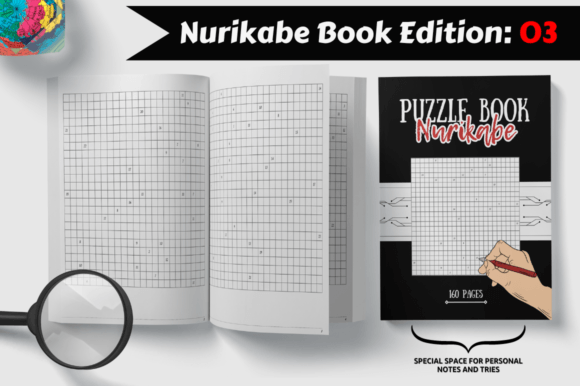
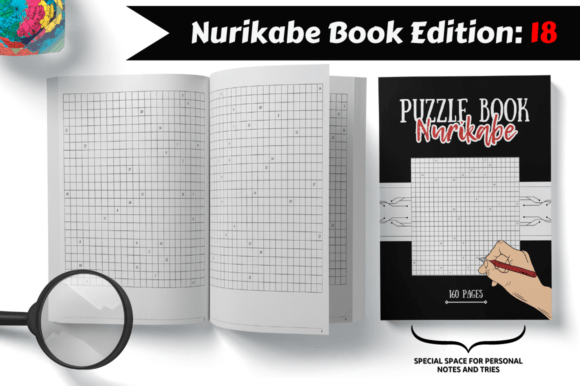
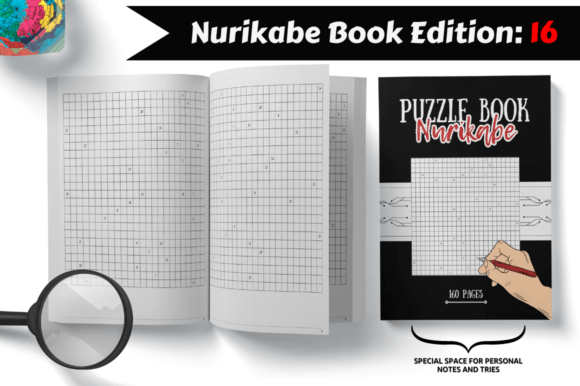
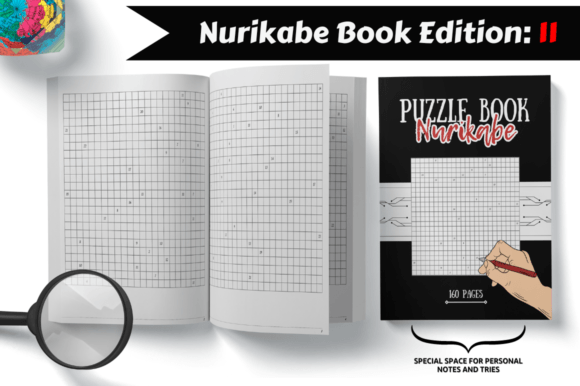
Not all puzzle books are created equal. A truly great collection respects the solver’s journey. When you browse for a Nurikabe puzzle book, look for features that go beyond just a heap of grids. An 8.5x11 inch layout, for example, is no accident—it provides ample space to jot notes, test candidates, and comfortably view the entire grid without eye strain. Clear, uncluttered printing makes a difference after an hour of focused concentration.
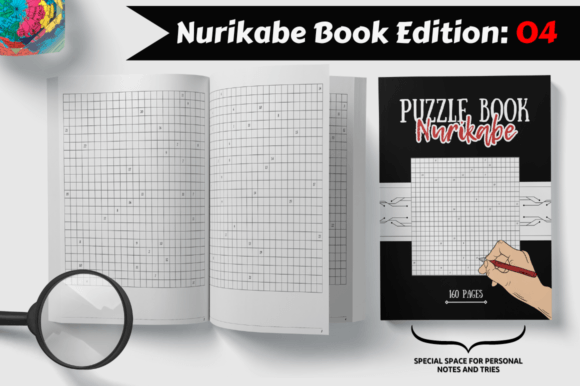
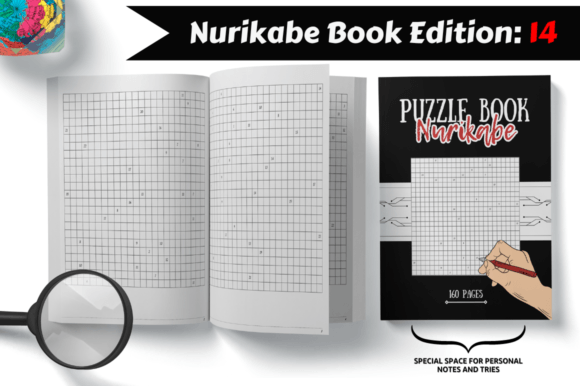
One standout example is a comprehensive 160-page volume that dedicates half its pages to puzzles and the other half to solutions. This balanced structure serves a dual purpose: beginners can peek at the step-by-step logic when stuck, turning every mistake into a learning opportunity, while experts can verify a complete solve or simply enjoy the security of knowing hints are available. The inclusion of a well-designed cover and keyword-optimized digital assets may not affect the solver directly, but it signals that the publisher cared enough to craft a polished, professional resource—one that interior designers and puzzle-loving gifters would be proud to include in a curated collection.
Solutions: More Than Just an Answer Key
The presence of a full solutions section often divides puzzle purists. Some view looking at the answer as a failure, but this misses the point. High-quality solutions pages can be used proactively: after solving, comparing your path to the official one reveals alternative deduction sequences. It’s like a chess player reviewing a grandmaster’s game. Even occasional peeking, when genuinely stuck, prevents the frustration that leads to abandoned puzzles. The goal is growth, not ego.
Nurikabe in the Classroom and Beyond
Educators have begun to recognize the power of logic puzzles as teaching tools. Nurikabe, with its visual nature, is particularly effective for developing spatial reasoning in students. Because the rules are intuitive and the puzzle requires no language fluency, it’s a universal challenge that can be introduced as early as upper elementary school. Students learn to form hypotheses, test them, and revise—a cornerstone of the scientific method. It also silently teaches persistence and the reality that some problems resist a quick solution.
In the professional realm, many software developers, engineers, and data analysts report enjoying Nurikabe as a form of low-stakes problem-solving that mirrors the logical structure of coding or system design. It scratches the same itch: you have constraints, a blank slate, and a deterministic outcome. When the day’s work involves ambiguous business requirements, the clean certainty of a well-constructed puzzle is a welcome reset.
How Puzzle Books Fit into a Modern Creative Life
The resurgence of physical puzzle books coincides with a broader cultural shift toward intentional hobbies. Knitting, journaling, and board games have all seen revivals. A Nurikabe puzzle book slides perfectly into this ecosystem. It can be a morning ritual with coffee, a lunch-break reset, or a wind-down activity before sleep. Families can photocopy a page and race to finish, turning a solitary pursuit into a friendly competition. Because each puzzle is self-contained, there’s no lengthy setup or cleanup—just open the book and begin.
From a content creator’s perspective, puzzle books also represent an accessible entry into self-publishing. The digital marketplaces are filled with books of varying quality, so a title that pairs meticulously crafted puzzles with a clean layout and helpful keywords stands out. A well-optimized listing might feature terms like “logic grid puzzles,” “Japanese puzzle book,” “brain teasers for adults,” or “island puzzle,” attracting both curious newcomers and die-hard fans.
Common Misconceptions About Nurikabe
Despite its simplicity, some misunderstandings crop up regularly. First, many assume that the wall must always separate every island from every other island. In truth, islands can touch each other diagonally; it’s only orthogonally that they must be separated by wall cells. Second, beginners often fear that the wall cannot form long straight lines. This is false—the wall can snake through the grid in narrow corridors as long as no 2×2 block appears. Third, the puzzle is sometimes mistaken for Hashiwokakero (Bridges) or other island-themed puzzles. While they share a Japanese heritage, the rules are completely distinct.
Another subtle point: the numbers do not indicate “height” or any kind of value ordering; a “5” island is not more important than a “2” island. They simply denote size. This often confuses solvers who unconsciously assign hierarchy. Clearing up these mental models early accelerates the learning curve.
From Solitary Hobby to Shared Passion
Online communities devoted to logic puzzles thrive on platforms like Reddit and specialized forums. Enthusiasts share tricky grids, debate advanced solving techniques, and celebrate the aesthetic appeal of a perfectly completed puzzle. Owning a dedicated Nurikabe book gives you a curated experience that’s often more thoughtful than randomly generated online puzzles, which can have multiple solutions or lack the human-designed elegance that creates a satisfying aha moment. When you find a book that has been hand-crafted or carefully checked for uniqueness and logical solvability, you’re engaging with a piece of puzzle art.
Gift-giving provides another dimension. A puzzle book is a thoughtful present for anyone who appreciates mental challenges—retirees keeping their minds sharp, students on holiday breaks, or friends recovering from illness who need quiet entertainment. A compact 8.5×11 volume with an attractive cover is substantial enough to feel like a real gift, not an afterthought.
Embarking on Your Nurikabe Journey
If this is your first encounter with the plaster-wall puzzle, you’re standing at the threshold of a deeply rewarding world. Start with a beginner-friendly collection that respects your inexperience—look for a mix of small grids, plenty of 1s and 2s to build confidence, and a solution section that teaches, not just reveals. As your fluency grows, graduate to larger grids where the wall twists like an intricate maze and the islands form complex archipelagos.
The beauty of Nurikabe is that every puzzle is a blank canvas just waiting for the precise application of logic to reveal its hidden order. There’s a quiet joy in uncovering that pattern—a joy that’s increasingly rare in our noisy world. So grab a pencil, find a comfortable chair, and let the invisible walls guide you to a calmer, sharper mind.
Pro Tip: Never solve in ink. The iterative nature of Nurikabe practically demands an eraser, and the faint marks of a tentative hypothesis are a testament to your evolving logic. Embrace the mistakes; they’re the stepping stones to mastery.
Whether you’re filling a quiet afternoon, building cognitive resilience, or searching for the perfect offline distraction, Nurikabe offers an elegant challenge with enduring appeal. The right puzzle book is your passport—and the islands are waiting.