Rethinking Daily Productivity with a Daily Goal Planner Printable Template
Most to-do lists fail before lunch. They pile up tasks without context, turning a simple day into a blur of unfinished reminders. The Daily Goal Planner Printable Template shifts that dynamic. Instead of managing infinite tasks, it invites you to anchor each day around a single meaningful objective—and then surrounds that anchor with the structure needed to actually move forward. It’s a deceptively simple tool, but its design reflects a growing understanding that clarity matters more than volume when you want to make consistent progress.
In a world where productivity apps fight for attention with constant notifications, there is a quiet resurgence of paper-based planning. People aren’t abandoning digital calendars—they are supplementing them with intentional, analog moments. This template fits neatly into that shift. It gives you a space to think, not just track. The sections for your daily goal, ideas, challenges, action steps, due dates, and notes create a narrative for your day, one that helps you remember why something matters before you dive into doing it.
The Evolution of Goal Planning in a Distracted Age
Goal setting used to be an annual event—ambitious resolutions scribbled in January and forgotten by spring. Today, people have moved toward smaller, more frequent planning rhythms. The rise of journaling, bullet journaling, and printable organizers reflects a collective need to break big ambitions into tangible daily actions. The Daily Goal Planner Printable Template embodies that micro-planning philosophy. It doesn’t ask you to map out five-year dreams. It asks you to choose what matters today—and then gives you tools to handle the friction that inevitably shows up.
Remote and hybrid work have also reshaped how we define a productive day. Without the built-in structure of an office, many professionals struggle to separate high-impact work from busywork. When you sit down with a printable planner that has a dedicated space for your daily goal and a separate space for challenges, you’re training yourself to anticipate obstacles before they derail you. That reflective pause is rare in purely digital workflows, where tasks appear as push notifications and disappear with a swipe.
There’s a psychological benefit to writing things down—research has long hinted that the act of handwriting engages the brain differently than typing. For a goal planner, that physicality can turn abstract intentions into something you feel more accountable to. And because the template is designed for print, it sidesteps the screen fatigue that so many knowledge workers experience by midday.
What Sets a Purpose-Built Daily Goal Template Apart
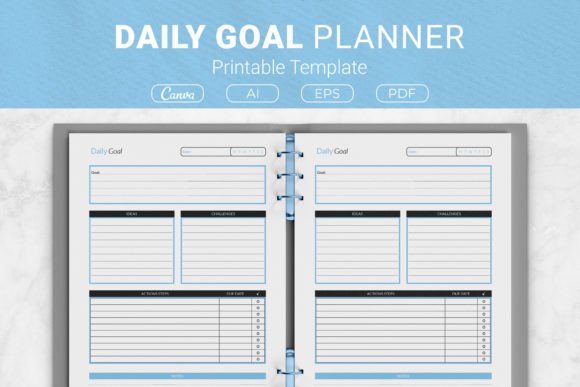
Not all planner pages are created equal. Some are beautifully decorated but functionally hollow. Others overwhelm you with hourly scheduling when all you need is directional focus. This particular template balances structure with flexibility. Let’s look at what each section actually does:
- Daily Goal: Instead of a long list, you commit to one central outcome. This sharpens decision-making throughout the day.
- Ideas: Creative thoughts and spontaneous insights have a place to land without disrupting your main flow. Many people lose these if they don’t capture them immediately.
- Challenges: By naming potential roadblocks upfront, you shift from reactive panic to proactive problem-solving. This section is a reality check, not pessimism.
- Action Steps: Breaking the goal into concrete, small moves prevents overwhelm and helps you start even when motivation is low.
- Due Dates: Gentle deadlines create accountability without the stress of minute-by-minute scheduling.
- Notes: An open space for reflections, follow-ups, or unexpected learnings. This is where daily planning becomes a feedback loop for personal growth.
When you use these sections together, the page becomes a conversation with yourself. You might write down a goal like “Finish the draft proposal,” list ideas about who to consult, acknowledge that the challenge is constant interruptions, then define action steps: close email, write for 45 minutes, review with a colleague by 2 p.m. The due date anchors it, and notes capture what worked or what didn’t. Over time, that pattern builds self-awareness, not just a checked box.
Customization as a Modern Necessity
One reason the Daily Goal Planner Printable Template resonates with users across different lifestyles is that it’s incredibly easy to adapt. You aren’t locked into someone else’s design. Because it comes as open-source AI Illustrator files, editable EPS files, and ready-to-print PDFs, you can tweak fonts, add branding, or rearrange sections to suit a team’s workflow or your own aesthetic. A freelance designer might want to change the header color; a productivity coach might add a client reflection prompt. The underlying structure supports that kind of personalization without breaking.
This adaptability also reflects a larger market preference. Consumers and small business owners increasingly want tools they can remix. The template package even includes a link to Canva templates, which opens the door for visual thinkers who may not have Illustrator skills but still want to customize their daily planning experience. It’s a thoughtful inclusion that lowers the barrier between wanting a tailored tool and actually having one.
From Personal Routine to Profitable Product
The versatility of this planner goes beyond personal use. With multiple size options—US Letter 8.5 x 11 inches, A4 210 x 297 mm, 7.5 x 9.25 inches, and 6x9 inches—it’s ready to fit different binding systems, home printers, and commercial print-on-demand platforms. This is where the template crosses into entrepreneurial territory. For those who create Kindle Direct Publishing (KDP) interiors, the Daily Goal Planner printable becomes a low-content book asset that’s immediately usable. You can design a full planner workbook, add a cover, and publish it with far less start-up friction than starting from scratch.
Low-content publishing has grown steadily because it bridges creativity and passive income. A well-designed daily goal journal can find an audience among busy parents, college students, remote workers, and anyone who feels stretched thin. The included formats—AI, EPS, and PDF—make it simple to integrate the template into a professional project while still preserving the option to keep it entirely personal. You might print it at home, punch holes, and store it in a binder for a completely offline planning ritual. That dual-use flexibility is where the template shines: it serves the solo user and the savvy creator equally well.
Building a Habit That Outlasts the Honeymoon Phase
Planners often sit empty after a week of enthusiasm. That’s rarely a design failure—it’s a habit failure. The structure of this daily goal planner is deliberately light enough to avoid burnout. A single page a day feels approachable. The act of filling it out shouldn’t take more than a few minutes in the morning and a brief review in the evening. Over time, this creates a cognitive rhythm: you start recognizing patterns in your challenges, you notice which action steps consistently lead to completion, and you become better at setting realistic due dates.
Real-world example: a content marketer might set a daily goal to outline three blog articles. In the ideas section, they jot down angles and keywords. The challenge is “getting caught in research loops.” Action steps become: set a 25-minute timer for each outline, close all browser tabs, and write without editing. The due date is end of workday. Notes at the bottom capture “drafts clearer when I separate research from writing—repeat tomorrow.” That small insight compounds across a month into a significantly more efficient process.
Another use case involves an educator managing hybrid classrooms. The daily goal could be “prepare interactive science module,” ideas might list potential online simulations, challenges include unreliable internet access, and action steps break the prep into offline and online components. By acknowledging the challenge beforehand, the teacher reduces frustration and adapts faster. The planner doesn’t magically fix infrastructure, but it creates a mental buffer against letting obstacles turn into excuses.
Why Printable Templates Are Gaining Ground in a Subscription Economy
We live in an era of recurring fees: software subscriptions, app memberships, cloud storage. Many people are experiencing subscription fatigue and looking for one-time purchases that give them lasting control. A printable template fits that model perfectly. You buy it once, download the files, and print as many copies as you need—forever. There’s no login wall, no feature updates that change the interface overnight, no data privacy concern. For the frugal professional or the privacy-conscious creator, that’s a compelling value proposition.
The environmental angle is more nuanced. Some worry that printing wastes paper, but many users report that a single printed page replaced multiple sticky notes, digital reminders, and scattered lists. When used thoughtfully, a daily planning sheet can actually reduce mental clutter and the constant device-checking that consumes energy. Plus, because the sizes include compact formats like 6x9 inches, you can print smaller, use recycled paper, or even bind sheets into reusable notebooks.
How to Get the Most from the Template Without Overcomplicating It
Start by resisting the urge to fill every line. The goal section works best when it’s one clear sentence. The ideas box can stay empty some days—creativity doesn’t always arrive on schedule. The challenges area becomes more valuable after a week of honest use, because you’ll start seeing recurring themes (interruptions, perfectionism, unclear instructions) that you can address systemically.
If you’re using the template in a professional context, consider printing a stack for the month and keeping them in a visible spot. For teams, you might share a modified version where the daily goal aligns with a sprint objective, and the notes section becomes a shared reflection tool during standups. The open-source AI Illustrator files make this level of adaptation straightforward for a designer or even a tech-savvy manager.
For KDP creators, a tip: layer the daily goal planner with other complementary templates—weekly reviews, habit trackers, or project breakdowns—and create a cohesive interior that solves a broader problem for your audience. The 7.5 x 9.25 inch size, in particular, tends to work well for paperback planner books that feel substantial but not bulky.
The Subtle Art of Daily Focus
Ultimately, a planner is only as good as the decisions it prompts. The Daily Goal Planner Printable Template doesn’t promise a miracle productivity overhaul, but it does offer a reliable framework for clarity. By distinguishing goals from ideas, action steps from challenges, and giving notes a permanent place, it helps you treat each day as a small experiment rather than a performance review. In a culture that often glorifies busyness, that mindset shift is quietly radical—and entirely practical.