How a Rugby League Playbook KDP Interior Can Refine Your Publishing Approach
Seeing Beyond the Layout: The Real Value of a Pre-Built Interior
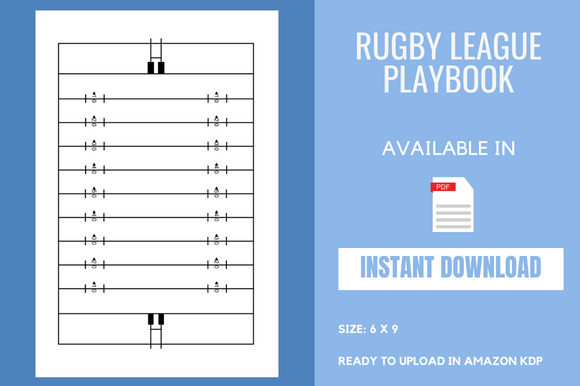
Most new self-publishers treat a KDP interior as a simple file to drag and drop. They overlook the strategic thinking already embedded in a well-constructed design. A Rugby League Playbook KDP Interior is not just a collection of blank pages with a header. It’s a purpose-built framework, often spanning 110 pages with a clean 6x9 trim size and correct bleed settings, designed so you can focus on market positioning instead of layout headaches. When you stop seeing it as a shortcut and start seeing it as a leverage point, your publishing decisions become much sharper.
This particular interior targets a niche audience—coaches, players, and analysts who need structured space for tactics, drills, and match analysis. Because the format is already aligned with how coaches think, you bypass the learning curve of designing from scratch. The main strategic advantage is speed: you can go from concept to live listing in a fraction of the time it would take to build, test, and proof a custom layout. But speed alone isn’t the point; it’s what the time saving allows you to do next—test multiple titles, invest more energy in cover design and description copy, or build a series under a single brand.
Why Thoughtful Publishers Use the Rugby League Playbook KDP Interior as More Than a Template
Many low-content entrepreneurs fall into the trap of scaling too fast with generic interiors and weak connections to an audience. The smarter move is to treat every interior as a part of your long-term positioning. The Rugby League Playbook KDP Interior works because it aligns with a repeatable use case. A coach buys this playbook not for the cover, but for the consistency of the inside pages—the way each drill diagram area sits next to a notes section, how the page numbers and subtle sports-themed headers create a professional feel. When your interior matches the mental model of your buyer, you reduce returns and increase organic reviews.
Using this interior strategically means you don’t have to wonder “Will the pages look right?” because the PDF is already finalized with bleed—a technical detail that, if handled poorly on a custom design, can cause printing errors and customer complaints. Instead, you can concentrate on differentiation. Perhaps you add a two-page introduction with coaching philosophy, a QR code to a video drill library, or a unique scoring system. The interior gives you a stable foundation; you build the recognizable experience on top of it.
Matching the Playbook to Your Larger Publishing Goals
Before you upload the file, pause and ask what result you want the product to deliver over the next 12 months. Is it a lead magnet that builds an email list for coaching services? A stand-alone passive income stream? A complement to a flagship book about rugby tactics? Each goal changes how you position, price, and promote the exact same Rugby League Playbook KDP Interior.
If your goal is passive income, consider bundling or creating a series with differentiated covers for various local clubs, age groups, or positional groups (forwards, backs). The consistent interior makes the series look cohesive while requiring minimal additional work. If the goal is branding, you might give the playbook away at a loss to establish authority before launching a higher-priced course. The interior itself becomes neutral; your strategy gives it commercial weight.
From Blank Slate to Outcome-Oriented Tool
The 110 pages inside this 6x9 book are intentionally undirected—they’re waiting for the user’s own diagrams and notes. That’s the hallmark of a strong low-content product: it doesn’t dictate how the buyer thinks, but provides enough structure to guide better thinking. For a coach, seeing dedicated spaces for “Opponent Analysis” and “Set Plays” might trigger a more organized week of planning. For you as the publisher, that psychological nudge at the page level is what turns a one-time purchase into a re-order when the book fills up.
So rather than simply slapping a cover on and calling it a day, ask yourself: “What micro-decisions will my buyer make while holding this book, and how can I reinforce trust?” Sometimes that’s as simple as choosing a heavier paper weight through KDP’s options, or clearly stating the interior design in your product images so customers understand exactly what they’re getting. The Rugby League Playbook KDP Interior makes those promises easier to keep because you can preview and guarantee the internal layout.
When to Choose a Pre-Made Interior Over a Custom Design
Custom layouts have their place, but they often introduce delays and costs that dilute the focus of a lean publishing operation. There are specific scenarios where the Rugby League Playbook KDP Interior is the sharper strategic choice:
- You’re validating a niche. If you aren’t sure whether rugby league coaches will buy a playbook, a pre-formatted interior lets you test with minimal investment. If the title sells, you can always release a second edition with custom features later, using revenue from the first.
- Time-to-market matters. When a rugby league season or World Cup event is approaching, speed is a competitive advantage. You can create season-specific playbooks quickly by simply updating cover graphics and keyword metadata.
- You want to reduce technical friction. The bleed setting is already implemented, page numbers are already placed, and the file is print-ready. Removing these points of failure means fewer rejections during KDP’s review process and faster publishing.
- You’re building a brand series. Consistency across multiple titles—playbook, training log, coach’s planner—becomes effortless when you reuse a tested interior. Customers begin to recognise your “look” without you having to re-hire a designer.
Practical Ways to Elevate the Rugby League Playbook KDP Interior Without Changing a Page
Some publishers worry that using a pre-made interior means their product won't stand out. In reality, the interior is rarely the main differentiator in a browsing shopper’s mind because it’s not visible behind the cover. You gain leverage by directing creative energy toward the elements customers do see first:
1. Contextual Cover Copy. Instead of generic phrases like “perfect for coaches,” speak directly to a specific frustration. For example, a back-cover line might read: “Designed for halftime adjustments: map attack shapes on the left page, track defensive gaps on the right. No more scribbling on loose paper.” This signals that the interior’s structure was chosen intentionally, even if you didn’t design it yourself.
2. Customer Experience Before the First Page. Consider a brief welcome message inside the book’s look-inside preview. While you can’t edit the interior PDF without altering the design, you can craft your product description and A+ Content to walk the buyer through the rhythm of the pages. Use screenshots of the actual layout to set expectations: “You’ll find a dedicated notes area opposite every play diagram—110 pages of clean 6x9 space, fully bleed-safe.” This transparency builds credibility.
3. Companion Digital Assets. Pair the print playbook with a simple digital download. Even a one-page PDF of common rugby field markings that the buyer can trace over adds perceived value. The physical Rugby League Playbook KDP Interior acts as the anchor, while the digital extra creates a reason to choose your version over a competitor’s. That combination shifts the offering from “just a notebook” to a lightweight training system.
4. Seasonal or Club-Specific Runs. Because the interior remains constant, you can produce limited variations without any layout rework. A 2026 season edition, a special “Women’s Super League” version, or a playbook themed for a specific rivalry all become possible just by swapping the cover file and updating keywords. This approach keeps your catalogue fresh while extending the life of a single interior file.
The Risk of Using a Rugby League Playbook KDP Interior Without a Clear Publishing Thesis
The greatest vulnerability isn’t plagiarism or saturation—it’s launching without a reason for being. Uploading the 110-page PDF and hoping the algorithm picks it up is not a strategy. If you can’t articulate who the book helps and how it helps them better than existing options, the interior’s quality becomes irrelevant. The market will treat it as interchangeable with any other sports notebook.
Another risk is treating all 6x9 interiors as one-size-fits-all. This rugby league playbook was built with bleed settings and page distribution that suit a coach’s note-taking style. If you simply re-title it for a completely different sport without adjusting language or context, your customer may notice a subtle mismatch. Even if they don’t, your listing might seem forced, hurting conversion. Align the exterior messaging with the sport psychology: rugby league coaches value structured, field-space thinking—make sure your product description and imagery echo that precision.
Finally, avoid the “upload and forget” mindset. KDP’s environment changes; print quality checks, category definitions, and even buyer expectations evolve. Revisit your listing periodically. Is the playbook still solving the right problem? Could a slight keyword shift from “rugby training journal” to “rugby league defensive pattern playbook” attract a more motivated buyer? A static interior can power a dynamic business if you don’t let the product page stagnate.
Planning Your Publication Timeline Around the Interior’s Strengths
Since the Rugby League Playbook KDP Interior requires almost no content creation, your bottleneck shifts to market timing. Look at the rugby league calendar: pre-season, State of Origin, international tests, grand finals. Launching a new playbook 4–6 weeks before a major event gives coaches time to discover it while they’re building their planning toolkit. During the off-season, pivot your ad messaging toward player development and long-term strategy, using the same interior but highlighting its reflection-friendly layout.
You might also adopt a portfolio approach. Publish the playbook as a standalone, then follow up with a supplementary “Opposition Scout Report” journal using the same base design with a slightly varied cover. The second product cross-sells the first. Over a year, a single interior file can support three or four interrelated products, each capturing a different search intent. This multiplies royalties without multiplying work—precisely the kind of compounding effect that separates intentional publishers from opportunistic ones.
Long-Term Decision-Making: When to Refresh or Retire the Interior
No digital asset stays relevant forever. Over time, you may notice shifting design trends—perhaps coaches begin asking for a landscape-oriented format, or a larger 8.5x11 trim for desk use. When that feedback accumulates, resist the urge to immediately overhaul the Rugby League Playbook KDP Interior. Instead, run a split test. Publish a new version with the updated layout as a separate ASIN, clearly labeled “Large Format Edition.” Keep the original live. Customer purchasing patterns will tell you whether the market genuinely prefers change or whether the vocal minority was simply loud.
Another long-term consideration is intellectual property. If you’ve built a brand around a specific interior style, consider how transferable that asset is. Could the same layout, stripped of rugby-specific headers, serve a general sports coaching market? If yes, you’ve created a reusable template factory. Document what made the 110-page Rugby League Playbook work: the bleed-safe margins, the note-to-diagram ratio, the section breaks. Then apply those principles to other niches with similar behavioral patterns—basketball drills, soccer formation planning, even esports team strategies. The original interior becomes a prototype, and your understanding of its strengths becomes your real moat.
Moving Forward With Intention, Not Just Files
The Rugby League Playbook KDP Interior isn’t a magic solution; it’s a container. What you pour into it—research, audience understanding, thoughtful positioning, clever bundling—determines whether it collects dust in a KDP dashboard or becomes a reliable income stream. Before you click “publish,” get specific about the problem you’re solving. Before you run an ad, confirm that your listing language matches the precise moment a coach decides to get organised. And before you move on to the next niche, ask whether you’ve maximized the potential of the asset you already have.
Treat every upload as a small business decision. The file details—six by nine inches, bleed settings applied, 110 pages—are listed in the product description, but the real product is the experience of using it. When you align that experience with a real coaching need, you stop selling notebooks and start selling preparation. That’s the shift that turns a ready-to-upload PDF into a strategic publishing asset.