Autoclave Log Book: Simple Daily Sterilization Tracker
In clinics, labs, and studios where instruments meet daily steam and ultrasonic waves, paper trails aren’t just busywork — they’re the quiet backbone of safety. A well-designed autoclave log book transforms repetitive record-keeping into a frictionless habit. Instead of generic notebooks or sticky notes, a purpose-made log takes the guesswork out of documentation for autoclaves, ultrasonic cleaners, and washer disinfectors. The right layout can cut the time it takes to record a cycle in half, while also making audits painless and non-confrontational. This particular log book doesn’t overwhelm you with unnecessary fields or cryptic abbreviations. It’s built for humans first.
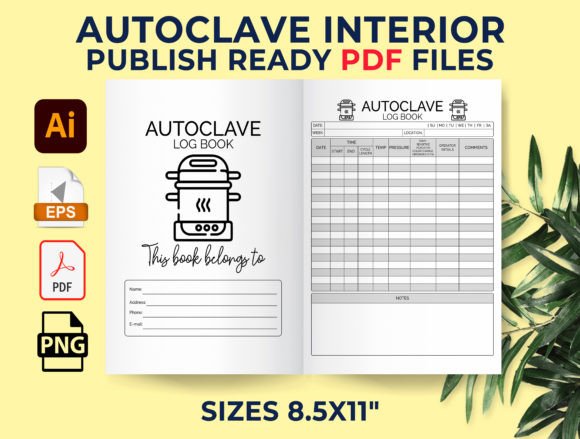
What immediately sets this log book apart is its restraint. It doesn’t try to be a multipurpose planner, nor does it shoehorn in irrelevant medical jargon. Every element on the page has a clear job, from the date line to the signature box. The book measures a substantial 8.5″ x 11″ — large enough that even hurried handwriting stays legible, but not so oversized that it becomes an awkward fit for standard shelving or clipboards. With 120 pages, it comfortably covers a full year of daily entries for a single machine, or several months of testing across multiple units if you run a busy practice with numerous devices. The subtle structure feels less like a bureaucratic hurdle and more like a helpful assistant keeping your quality control on track.
Why a Purpose-Built Log Book Matters
Generic log sheets downloaded and printed from a dusty template often fail in the real world. They might lack space for notes, cram too many days onto one page, or use fonts so tiny that technicians skip fields out of frustration. A dedicated autoclave log book designed around actual workflows changes that dynamic. The per-day format gives each date its own clear block, removing the temptation to “bunch” cycles together and inadvertently obscure individual test results. When a spore test fails or a cycle time seems off, having separate entries for morning and afternoon loads can pinpoint exactly when the issue occurred. This level of granularity is nearly impossible on a cramped, community-published sheet.
But design isn’t just about usability — it also telegraphs professionalism. When a visiting inspector or accreditation body asks to see your sterilization records, handing over a cohesive, well-maintained log book with an intro page that outlines your protocol speaks volumes. It shows that infection control isn’t an afterthought. It’s a brand statement for the practice. Even if clients never see this book, the consistent, tidy layout subconsciously reinforces to your staff that details matter. That small psychological nudge can improve compliance rates more than a dozen laminated posters.
Inside the Layout: Daily Simplicity Meets Professional Finish
Open to any page and you’ll find a refusal to complicate the simple. The design uses a crisp, no-bleed interior: tables and text stay well within the trim boundary, so nothing gets lost in the gutter or trimmed off during professional binding. This is especially important if you’re printing copies through a local shop or using an online print-on-demand service. Margins breathe, giving the page an airy feel that invites you to write rather than dread the task.
Per-Day Format and Note Space
The core of the log is the per-day section, which typically includes fields for date, machine type, operator, cycle parameters, chemical indicator results, biological test outcome, and a space for initials. Crucially, the layout leaves space for writing notes without shrinking the primary grids. Something unexpected happened during the run? You can jot it down immediately — no need to find a separate incident report form. Maybe a washer disinfectant cycle ran long, or a Bowie-Dick test showed faint streaking. Having that note right next to the corresponding data keeps contextual clues alive, which is gold for maintenance staff trying to diagnose a recurring problem.
The note area is generous without becoming wasteful. For a typical 8.5×11 page, you might see the daily block taking up about a third of the vertical space, leaving the rest for the next day’s entry or for additional comments. This rhythm makes flipping through the book feel consistent; your eye knows exactly where to land for the current date. No searching. No accidental skipping of lines.
Print-Ready Quality and High Resolution
Behind the pages lies serious production intent. The deliverable includes a high-quality print-ready PDF rendered at 300 DPI — the gold standard for crisp, professional output. Whether you print one copy at a time on a laser printer or send a bulk order to a commercial offset press, the fine lines of the tables stay razor-sharp and the type remains perfectly readable. Text doesn’t break up, micro-details like checkbox squares stay square, and tonal fills (if any) avoid banding. For a log book that’s handled daily, durability of print matters, and 300 DPI ensures photocopies or scans retain their integrity.
The book uses a no-bleed setup, which simplifies the printing process dramatically. You don’t have to fiddle with extended margins in your printer dialog, and you can even bind the pages into a three-ring binder or use comb binding without losing content. This is a small but meaningful technical choice that reduces end-user frustration — the sort of thing only an experienced designer would include in the specification.
Who Benefits Most from This Log Book Design
On the front lines, dental assistants, sterilization techs, veterinary nurses, and tattoo artists all need to record cycle data for autoclaves, ultrasonic baths, and washer disinfectors. For them, the log book is a daily companion. The simple tracking approach means new hires can be trained on the log in under five minutes. There’s no cryptic legend to decode, no tiny print that requires a magnifier — just straightforward, well-spaced fields that follow a logical order from machine identity to final sign-off.
For the practice owner or clinic manager, the book doubles as a compliance shield. Because each day stands alone, it’s easy to pull a week’s worth of records without photocopying half the book. Auditors can verify biological test frequency at a glance, and the intro page you can populate with your specific protocols turns a passive record into an active policy document. On top of that, the consistent visual format means that if you ever need to digitize the logs (scanning them into a PDF for a health department), the clean pages produce clear, OCR-friendly scans.
Using the Editable Files for Branding and KDP Publishing
Designers, entrepreneurs, and content creators will find the included source files just as valuable as the finished PDF. The package comes with AI, EPS, and PNG versions alongside the PDF. That means you can open the log book in Adobe Illustrator or another vector editor, swap out the placeholder clinic name for your own, tweak the color of the table headers, or even add a custom logo to every page. Need to translate the field labels into another language? You can do that directly in the EPS or AI file without losing any formatting, because the structure is built with clean, organized layers and live text (provided the original font is available or easily substituted).
This flexibility is a huge time-saver for anyone planning to sell on Amazon KDP. The file has been KDP tested with no errors, meaning the interior PDF passes Amazon’s automated print checks: the trim size aligns, margins are safe, images (if any) are high-resolution, and there are no transparency problems. For a print-on-demand publisher, that’s half the battle won before you even customize the cover. You could quickly create a series of themed log books — a version for veterinary clinics with a pawprint-emblazoned cover, a version for dental offices with a tooth icon, or a universal edition with a sleek minimalist cover — all from the same interior source files. The AI file’s layered structure typically supports recoloring, moving elements, or swapping out the table layout to match a branding palette.
A Designer’s Perspective on the Included Assets
From a visual standpoint, the interior typography uses a clean, functional typeface — likely a neutral sans-serif with open counters and a comfortable x-height. It doesn’t attempt to be decorative, because in this context readability is the sole job of the font. The line spacing is generous enough to keep the grid from feeling crushed, and the rule weight of the table borders is consistently light, so as not to compete with handwritten entries. This is the hallmark of good information design: the structure frames the content without bullying it. Even if you don’t change a thing, the existing design feels authoritative, modern, and universally appropriate for clinical or lab environments.
For those building a brand around quality control, the consistent aesthetic of this log book can be extended to other stationery: appointment books, client intake forms, or inventory sheets. The AI and EPS assets give you a springboard to create a cohesive printed suite. A branding strategist could pull the same shade of grey from the table lines and apply it to letterhead, creating a subtle visual link that reinforces the practice’s identity.
Practical Tips for Integrating the Log Book Into Your Workflow
Start by placing the log book next to the autoclave or workstation. A simple ring-bound copy opened to the current day reduces friction significantly. Fill out the date and machine information at the beginning of each shift, so the only thing left during a busy cycle is to jot down the load details. Use the note space proactively: if you observe a slight pressure variation that still falls within acceptable range, note it. Over weeks, these notes often reveal patterns — a solenoid that’s starting to stick, water quality drifting, a tray that consistently fails the chemical indicator. The log becomes a diagnostic tool, not just a compliance record.
If you’re reprinting the book from the source files, consider which binding suits your environment best. A plastic-coil binding allows the book to lie flat, which is ideal for writing while standing. A spiral with a heavy-duty cover protects the pages from humidity near a sterilizer. If you’re printing at a copy shop, ask for a clear laminate on the front and back covers; combined with the 8.5×11 size, this makes the book durable enough to survive a full year in an active clinic.
For KDP sellers, market the log book by showing not just the cover, but also an interior preview. Highlight the per-day format and the generous note area. Mention that it’s compatible with quick home printing if the customer buys the PDF template and prints it themselves — not everyone needs a professionally bound version. The multiple formats allow you to offer both a physical book on Amazon and a downloadable template on Etsy or Gumroad, maximizing your reach. Since the design is already tested to pass KDP checks, the technical side is largely risk-free.
The Unseen Impact of Good Design on Compliance
It’s easy to overlook how strongly a layout influences behavior. A chaotic, ink-smeared log sheet signals that record-keeping is a nuisance, and staff may treat it accordingly. In contrast, a thoughtfully structured autoclave log book communicates that accuracy matters. The clear separation between days, the presence of an intro page, the consistency of the table grid — these elements work together to reduce cognitive fatigue and prevent entry mistakes. When the book is pleasant to use, people are more likely to fill it out completely, in real time, rather than rushing to catch up at the end of the week. That’s not just good design; it’s a direct contribution to patient and client safety.
For entrepreneurs and publishers selling this design, that same attention to detail becomes a selling point. Buyers in the dental or veterinary space often search for terms like “autoclave log book, 120 pages, per day format” and they can spot a half-hearted template immediately. By offering a product that genuinely solves the user’s problem — crisp printing, no-bleed layout, space for notes, and editable source files for easy branding — you’re not just selling a book; you’re selling a tool that becomes part of a clinic’s daily ritual. That kind of value builds repeat customers and positive reviews far more reliably than a generic interior with low-resolution blur.