Maze Puzzle Activity Book Edition 05: A Strategic Tool for Mental Clarity and Creative Problem-Solving
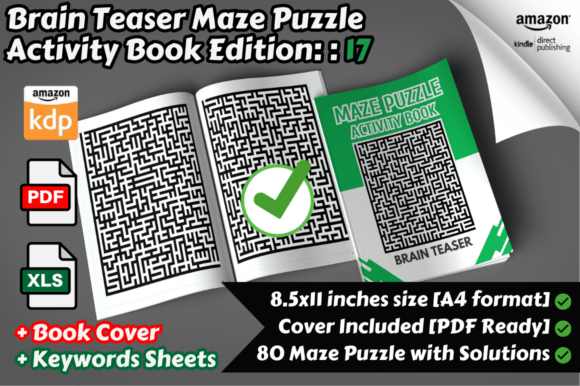
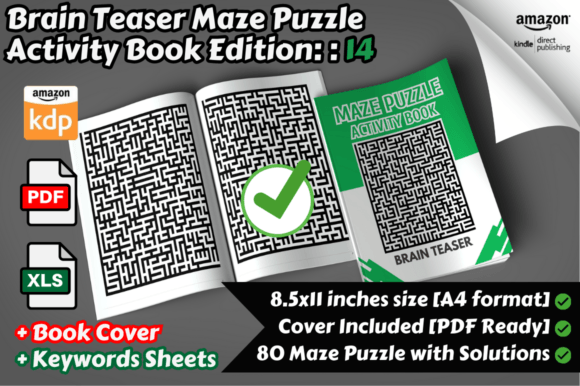
Sharpening cognitive function and maintaining creative momentum often requires stepping away from the primary task at hand without disengaging the mind entirely. Physical workouts build muscle; mental workouts build neural pathways. For professionals, creators, and lifelong learners, a structured puzzle activity offers a reliable way to reset focus, practice logical reasoning, and inject a dose of playful challenge into an otherwise rigid schedule. The Maze Puzzle Activity Book Edition 05 arrives as a carefully composed resource that fits neatly into this space. It is not a collection of casual doodles or haphazard brainteasers. It is a 160-page PDF designed for adults who value process, consistency, and intentional breaks, whether they are planning a marketing campaign, teaching a class, managing freelance projects, or simply looking to preserve mental sharpness over time.
What Exactly Is Maze Puzzle Activity Book Edition 05?
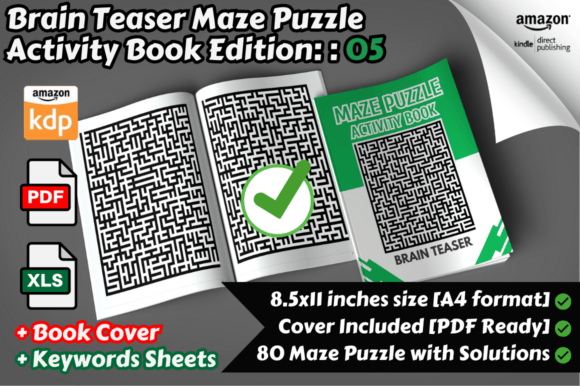
At its core, this is a downloadable PDF activity book formatted at 8.5×11 inches. The total 160 pages are evenly split between two distinct sections: 80 pages of original maze puzzles and an additional 80 pages containing the solutions. There is no fluff, no filler content between challenges. The structure is straightforward. You open the file, print or load a maze, and begin solving. Once you have worked through the puzzle, you can flip to the solution section to verify your path, analyze any missteps, and move on. The separation of puzzles and solutions is deliberate; it preserves the integrity of the solving process because you are not tempted to glance at the answer while engaged with the maze itself.
The term “Edition 05” might suggest a series, and indeed it represents an iteration that focuses on diverse maze designs, escalating complexity, and a clean, printer-friendly layout. For anyone who has previously used activity books, this edition refreshes the collection with new patterns, dead ends, and route variations that challenge spatial reasoning and patience without becoming frustratingly obscure.
How Maze Solving Fits Into a Broader Cognitive Workflow
Solving a maze looks simple on the surface: trace a line from start to finish. But the mental mechanics involved mirror several professional and creative tasks. Maze solving exercises visual scanning, working memory, and forward planning. You must assess the entire layout, recognize false paths, backtrack efficiently, and hold partial solutions in mind while testing new branches. This is comparable to troubleshooting a software issue, mapping a customer journey, structuring a lesson plan, or editing a draft. The book becomes a low-stakes simulator for the kind of flexible thinking that complex work demands.
When used before a task, a short maze session warms up the brain, much like a musician playing scales before a performance. It primes neural circuits for pattern recognition and sustained attention. When integrated during a task, rapid puzzle-solving can act as a micro-break that prevents cognitive fatigue without pulling you completely out of flow. And after a demanding session, the act of completing a maze provides a concrete sense of closure, a small but meaningful win that signals the brain to shift gears and recharge.
Practical Integration Tips for Different Professional Routines
The digital format and print-ready design make the Maze Puzzle Activity Book Edition 05 unusually versatile. Here is how it can become part of various real-world workflows without disrupting productivity:
- Remote workers and freelancers: Keep the PDF open on a tablet or secondary screen. Between focused Pomodoro intervals, solve one maze using a stylus or finger. It resets visual focus away from spreadsheets and email threads while keeping the mind moderately engaged. No social media scrolling required.
- Marketers and content creators: Creative blocks often stem from linear thought patterns. A difficult maze forces non-linear thinking. After solving, return to a campaign brief or blog outline with refreshed mental flexibility. The solution section serves as a reminder that even elaborate problems have a mapped route.
- Educators and trainers: The 8.5×11-inch print size is ideal for classroom handouts. Because the PDF provides separate answer keys, teachers can print only the puzzle pages for students and later project or share the solutions for group discussion. Mazes support visual-motor integration and patience, valuable in special education, art classes, and logic workshops.
- Entrepreneurs and small business owners: Decision fatigue is real. Keeping a printed maze at the desk provides a quick, undemanding mental reset between high-stakes calls or budget planning. The tactile nature of pencil-on-paper (if you print) adds a grounding sensory element that digital-only tools often lack.
- Publishers and activity book resellers: This product itself becomes a raw asset. The PDF can be licensed, printed, and bound as part of a larger product line, or repurposed as lead magnets and membership bonuses. Because it is a ready-made, solved book, quality control is already handled: the solutions are verified, the layout consistent.
Format Factors That Influence Long-Term Usability
The decision to deliver the activity book as a high-quality PDF with a standard letter size (8.5×11 inches) is not accidental. It solves several practical problems. Users can print at home or through a professional service with zero formatting adjustments. The large page size gives each maze generous whitespace, reducing eye strain and allowing for clear pencil lines. If you prefer a reusable option, you can print once and place the sheet inside a plastic sleeve to use with dry-erase markers. When traveling, the entire PDF sits on a phone, laptop, or cloud storage, weighing nothing and taking no baggage space.
Separating the solutions into a dedicated 80-page block is a quiet but powerful design choice. In some puzzle books, the answer is printed on the reverse of the puzzle page, which undermines the challenge. Here, you build a small ritual: solve, then intentionally navigate to the solution section. This reinforces a sense of completion and encourages honest self-assessment. Over time, you learn to recognize your own improvement: fewer wrong turns, faster solve times, less impulse to glance at the answer.
Using the Book for Consistent Mental Conditioning
Sporadic use yields sporadic benefits. The Maze Puzzle Activity Book Edition 05 contains enough material to support a structured routine across several weeks or months. If you treat it like a gym program, you might decide to solve one maze every morning with coffee, or three mazes on a dedicated slow Sunday afternoon. The gradual increase in puzzle complexity acts as progressive overload for your problem-solving muscles. You do not need to log performance metrics; the act of persisting through trickier mazes and self-correcting after a solution check is itself the feedback loop.
For teams, a shared PDF license allows each member to print and solve the same maze. This creates a low-pressure collective activity: discuss strategies, compare routes, and laugh about dead ends. It humanizes the work environment and subtly encourages collaborative problem solving without the stakes of a calendar deadline. The cost of entry is a single download and some printer paper.
Quality Control and Organizational Consistency
One underappreciated aspect of a well-made puzzle book is visual clarity. Poorly designed mazes with thin, jagged lines or ambiguous intersections lead to frustration rather than productive challenge. The engaging designs in this edition are built for readability. Paths are distinct, spacing is consistent, and the start and finish are unambiguously marked. When you are 45 minutes into a difficult maze, the last thing you want is to question whether a gap is a path or a printing artifact. This reliability allows you to trust the puzzle and focus fully on your solving strategy.
Organizationally, the PDF format means you can archive different puzzle sets, reprint favorites, or compile a custom booklet. For example, if you know Mondays are light and Fridays are intense, you could pull easier mazes for start-of-week warmups and tougher ones for end-of-week challenges. The edition’s self-contained nature—puzzles plus solutions, all in one file—eliminates the need to track down separate answer keys or risk losing them.
Where This Fits Among Other Productivity and Learning Tools
The Maze Puzzle Activity Book Edition 05 doesn’t replace meditation apps, project management software, or professional development courses. It sits alongside them as a tactical micro-tool. You might mix it with bullet journaling: draw a small maze into your morning spread, then solve it to symbolically kick off the day. Or pair it with research-heavy work: after reading dense material, a maze helps your brain shift from passive consumption to active routing. Compared to digital brain-training apps, the PDF version removes screen time and notifications, offering a distraction-free zone. This is increasingly valuable as so much work happens on glowing rectangles.
Bloggers and content reviewers can use the book as a prop for productivity or self-care posts, demonstrating authentic analog breaks. Coaches might recommend it to clients struggling with perfectionism; a maze has one correct path but multiple near-misses, teaching that errors are just detours, not failures. The adaptability of the format means it can be printed on various paper stocks, hole-punched for binders, or even projected onto a whiteboard for group think-tank sessions.
Implementation Without Overcomplication
Adopting a new tool often fails when the setup process is cumbersome. The Maze Puzzle Activity Book Edition 05 removes friction. Immediately after purchase, you have a PDF. Print a few pages. Keep a pencil nearby. The first maze takes minutes; you do not need to read instructions or learn rules. This immediacy makes it easy to sustain because there is no onboarding period. If you later decide to digitize the solving experience, you can import the PDF into a note-taking app like GoodNotes or Notability and use a stylus. But the analog baseline remains accessible for anyone with a basic home printer.
For those who publish their own activity content, this edition also serves as a standard of comparison. The layout, solution separation, and consistent puzzle density model a professional approach. Study how the mazes escalate in difficulty, how the page margins handle binding needs, and how the solutions are presented without clutter. These are practical lessons you can apply to your own creations, reducing the trial-and-error that often accompanies DIY puzzle books.
Long-term, the greatest value might simply be the normalizing of intentional mental breaks. In a culture that treats busyness as a virtue, pausing to trace a maze can feel countercultural. Yet the clarity that follows is measurable. A mind that practices sequencing routes, overcoming dead ends, and celebrating solo completions is better wired for the ambiguous, non-linear problems that define modern work. The Maze Puzzle Activity Book Edition 05 provides a structured, reusable, and honestly enjoyable way to build that wiring.