Kakuro Puzzles Activity Book Part 20
There is a quiet moment that arrives between commitments. Maybe it is early morning with coffee, or the half-hour after a project wraps up when the mind still needs a place to land. Many people reach for their phones. A growing number reach for a pencil instead. Kakuro Puzzles Activity Book Part 20 occupies that space with purpose—offering something structured enough to engage but open enough to restore.
Kakuro sits at an unusual intersection. It borrows the grid logic of a crossword and the numerical constraints of sudoku, yet it produces a completely distinct mental rhythm. Each puzzle presents a grid with blank cells and small clue numbers tucked into shaded corners. The task is to fill every blank with a digit from 1 to 9 so that the sum of each run matches its clue, with no digit repeating within a single sum. The arithmetic is basic. The reasoning is not.
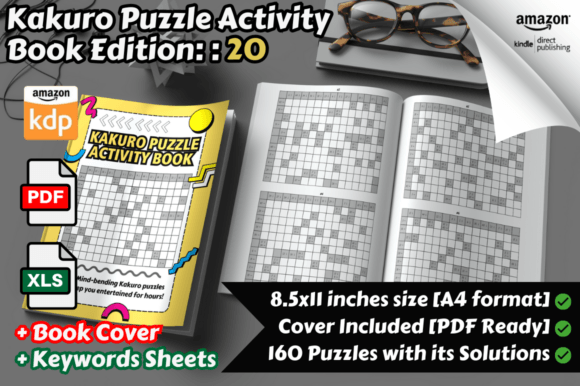
This twentieth installment in the series refines what loyal solvers have come to expect while remaining genuinely accessible to newcomers. What makes the book particularly useful is how it has been assembled as a ready-to-print resource. The interior PDF file is sized at 8.5 by 11 inches, a standard that works with virtually any home or office printer. There is no awkward resizing, no clipped margins, no formatting that collapses when paper meets ink. The design choice may seem minor, but anyone who has wrestled with poorly laid-out printable content will recognize its practical value immediately.
How Kakuro Puzzles Activity Book Part 20 Supports Mental Clarity
Puzzle-solving is often described as a workout for the brain, and that metaphor holds up reasonably well. What matters more is the type of workout involved. Kakuro demands a particular kind of sustained attention. Unlike quick-hit trivia or word searches, each puzzle requires holding multiple constraints in mind simultaneously while testing partial hypotheses against the available clues.
For a marketing professional who has spent the morning analyzing spreadsheets, shifting into a different numerical mode can feel strangely refreshing. It uses numbers, yes, but the purpose is discovery rather than optimization. For a blogger or content creator whose work depends on verbal fluency, the switch from words to digits can quiet the linguistic loop and activate a complementary cognitive channel. There is a reason some of the most focused thinkers throughout history gravitated toward number puzzles during breaks—they provide a bounded container for concentration without depleting the same reserves the primary work requires.
The book dedicates 80 pages to puzzles alone. That volume matters. It means a single purchase supports weeks or months of daily practice, depending on pace. A solver who completes one puzzle each morning can stretch the book across nearly three months. Someone who dives in during flights, waiting rooms, or weekend afternoons might move faster, but the depth remains. Because difficulty ramps gradually across the collection, early wins build confidence while later grids genuinely test the patterns learned along the way.
Clear Solutions and the Value of Fast Feedback
An often-overlooked feature of any puzzle book is its answer section. Kakuro Puzzles Activity Book Part 20 includes a full 80 pages of solutions, matching each puzzle page one for one. This structure eliminates the friction of flipping to a cramped appendix at the back or decoding tiny grids squeezed four to a page. Each solution sits on its own page with the same spacious layout as the puzzle it answers.
Fast feedback accelerates learning. When a solver hits a contradiction—two sixes in the same run, a total that overshoots the clue—checking the solution immediately clarifies whether the mistake was arithmetic or logical. Over time, pattern recognition improves. Solvers begin to notice that certain clue combinations permit only one possible digit arrangement, and they internalize these as tools rather than memorizing them as trivia. The structured solution section turns the book into something closer to a self-contained learning system than a disposable pastime.
A Printable Resource Designed for Flexibility
Not every puzzle enthusiast wants to solve on screen. Some prefer paper, the tactile click of a pencil, the ability to jot small candidate numbers in corners without switching to a digital annotation tool. The PDF format of this book respects that preference. The interior file is professionally built for clean output on standard letter paper. Margins leave room for notes. Grids are crisp without being cluttered. Printing a handful of pages before a trip or a long meeting takes seconds and yields something immediately usable.
This flexibility extends to how different audiences might deploy the material. A teacher or educator could print select puzzles for students who finish early and need a quiet challenge that builds number sense without feeling like extra math homework. A small business owner might keep a few printed sheets in the break room as a low-cost way to offer employees a mental reset. A freelancer working from a co-working space could tuck a printed puzzle into a notebook for moments between calls when doomscrolling is the less appealing alternative.
Who Gains the Most from Kakuro Puzzles Activity Book Part 20
The profile of an ideal solver is not defined by math background or puzzle experience. It is defined by a desire for focused, screen-free engagement that produces a tangible sense of completion. That said, certain groups may find the book particularly well-aligned with their daily rhythms.
Professionals in high-cognitive-load roles—analysts, developers, strategists, editors—often benefit from puzzles that use different mental machinery than their primary work. Kakuro is numerical but not quantitative in the business sense. There are no forecasts, no probabilities, no optimization curves. There is just a small, solvable problem that yields to careful thought. That distinction matters for mental recovery.
Creators and entrepreneurs whose days involve open-ended problem solving may appreciate the opposite: a closed system with clear rules and a single correct answer. When so much professional life involves ambiguity and trade-offs, spending twenty minutes on a puzzle where everything resolves neatly can provide a small but meaningful psychological reset.
Publishers and content sellers will note an additional dimension. The package includes an Excel spreadsheet populated with relevant keywords, which supports discoverability for those who plan to list or distribute the book through digital marketplaces. This is not a feature the average puzzle solver needs to think about, but for someone building a catalog of printable products, it removes a significant research step and helps the book reach the audience it was designed for.
Design Quality and the Finished Look
A professionally crafted cover file accompanies the interior PDF. For buyers who intend to print and bind a physical copy—or offer it as a downloadable product in their own store—the cover provides a polished, attractive presentation that signals quality at first glance. The visual coherence between the cover and interior layout reflects attention to detail that experienced creators and publishers tend to notice and appreciate.
Small details accumulate. The font choices remain legible against the grid. The spacing between clue boxes and blank cells stays consistent across pages. The overall impression is of a resource built with care rather than assembled in haste. In a market flooded with low-effort puzzle books, this level of attention separates a product people keep using from one they abandon after three pages.
Practical Use Cases Across Different Settings
Imagine a Sunday afternoon where family members gather around the kitchen table, each with a printed puzzle page from the same book. Some work independently. Others collaborate across generations—a parent explaining the logic to a teenager, siblings racing to finish first. The book supports these moments without requiring apps, accounts, or Wi-Fi. It simply exists as a stack of paper and a box of pencils, ready when people are.
Consider a content creator who films puzzle-solving sessions for a YouTube channel or social media. The clean, large-format grids photograph well. The gradual difficulty curve provides a narrative arc across multiple videos. Solutions are available for verification without breaking the flow of recording. The book becomes not just a pastime but a production asset.
Think about a freelancer between contracts. The unstructured days can blur together. A morning Kakuro puzzle offers a small ritual—a concrete task completed before the inbox fills with uncertainty. It is not productivity in the economic sense, but it is motion. And motion often leads to momentum.
Recommendations for Getting the Most from the Book
Start where you are. If new to Kakuro, spend extra time on the early puzzles even if they feel straightforward. The goal is not speed but understanding the logical shortcuts that make harder puzzles solvable without guessing. Look for pairs—clue sums like 3 (which must be 1 and 2 in a two-cell run) or 17 (which must be 8 and 9). These small certainties become anchors that stabilize larger sections of the grid.
Print on slightly heavier paper if you plan to erase. Standard copy paper works, but 24-pound or higher resists ghosting when pencil marks are removed. Keep printed puzzles in a folder or clipboard so they travel well. Treat the book as a renewable resource—print what you need, solve at your pace, and reprint pages when you want a fresh attempt.
For those who struggle with a particular puzzle, resist the urge to check the solution immediately. Step away for ten minutes. Come back with fresh eyes. Often the brain processes the problem in the background and returns with a clearer view. The solution pages serve as safety nets, not crutches.
Potential Considerations and Fit
No single product suits everyone. Kakuro puzzles involve arithmetic, and while the math stays at an elementary level, the combination of numbers and logic can initially feel unfamiliar to those accustomed only to word-based or visual puzzles. The learning curve is real but short—most solvers find their footing within two or three puzzles. Anyone willing to invest that initial patience will likely discover a deeply rewarding format.
The PDF format offers flexibility but requires access to a printer for those who prefer paper solving. Digital solvers working on tablets with stylus support will find the file works smoothly in annotation apps, though this requires a compatible device and software. The large 8.5-by-11-inch pages, excellent for print clarity, may feel oversized on smaller tablet screens; zooming and panning become necessary, which some users find acceptable and others do not.
Compared to subscription puzzle apps or websites that generate endless content algorithmically, Kakuro Puzzles Activity Book Part 20 offers a finite but carefully curated set. The trade-off is between unlimited volume and intentional design. For solvers who value curation over quantity, the book's 80-puzzle collection represents depth rather than limitation. For those who want an endless feed, a complementary app might fill gaps between printed sessions.
The Satisfying Weight of Completion
There is a particular experience that comes with filling in the final digit of a challenging Kakuro grid. The numbers, so stubbornly elusive minutes before, now sit in perfect agreement with every intersecting clue. The mind registers completeness. It is a small victory, entirely personal, and it carries a quiet satisfaction that outlasts the moment.
Kakuro Puzzles Activity Book Part 20 delivers that experience repeatedly across its pages. It does so without demanding passwords or updates. It asks only for attention, and it returns something genuinely restorative. In an era of fragmented focus, that exchange feels increasingly valuable.
The book also makes a thoughtful gift. Friends who enjoy logic puzzles, colleagues who appreciate analog breaks from digital work, family members who gather around shared activities—all may find something to enjoy. The printable format even allows for creative gifting: print a selection, bind it simply, and present a hand-assembled puzzle collection tailored to the recipient's skill level.
Whether you solve alone in the quiet of early morning or across from someone you care about on a lazy afternoon, the experience shares a common thread. Each puzzle is a small world of order, waiting to be understood. And understanding, however modest its domain, never gets old.