Exploring Kakuro Puzzles Activity Book Part 06
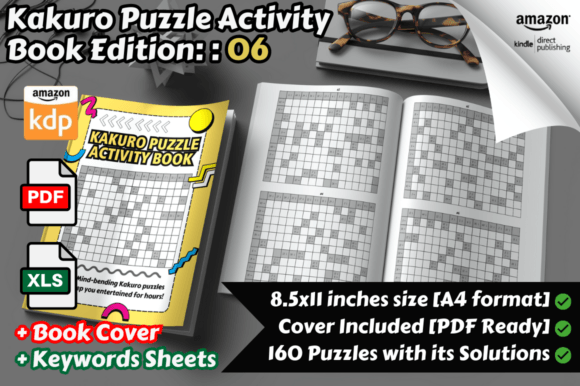
There is something quietly satisfying about sitting down with a puzzle that asks for nothing more than a pencil, a bit of patience, and a willingness to think differently. Kakuro Puzzles Activity Book Part 06 arrives as the latest installment in a series that has steadily gained traction among people who want their leisure time to carry a little more weight. It is not just another collection of number grids. It is 80 pages of carefully constructed Kakuro challenges paired with 80 pages of solutions, all wrapped in a professionally designed interior that respects the solver's experience.
For those unfamiliar, Kakuro sits at an unusual crossroads. It borrows the grid logic of a crossword and pairs it with the numeric satisfaction of Sudoku. You are given a set of sums, and your task is to fill each blank cell with a digit from 1 to 9 that makes every horizontal and vertical run add up correctly, without repeating a digit within any single sum group. It sounds simple. The deeper you go, the more nuance you discover. That gradual unfolding of difficulty is precisely what Kakuro Puzzles Activity Book Part 06 has been designed to deliver.
What Actually Lives Inside This Volume
The book is built around a straightforward premise. You get 80 puzzle pages and 80 solution pages. That one-to-one ratio matters more than it first appears. Many puzzle books skimp on answer sections or cram them into tiny, unreadable formats. Here, every puzzle has a dedicated, clearly presented solution on a corresponding page. You can check a single answer without spoiling the next challenge. For anyone who has ever flipped back and forth in frustration, this small design choice signals genuine thoughtfulness.
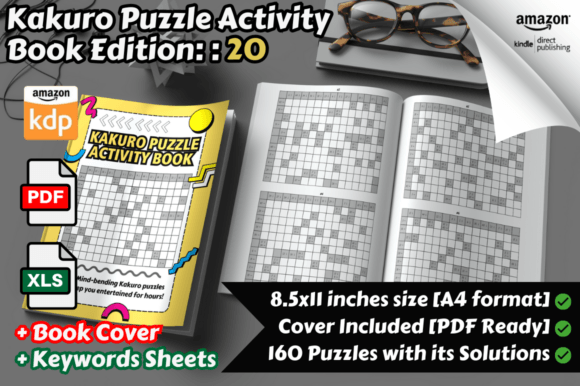
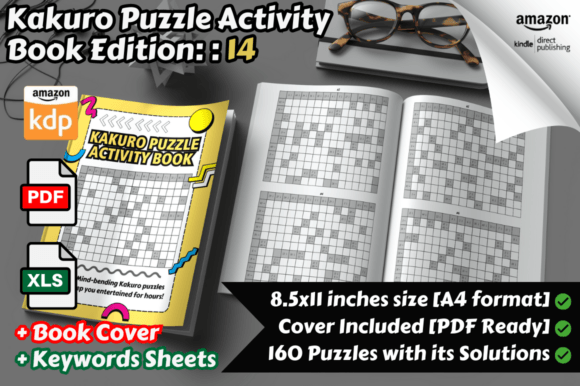
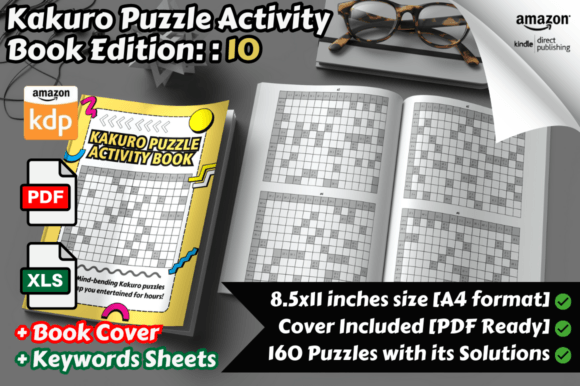
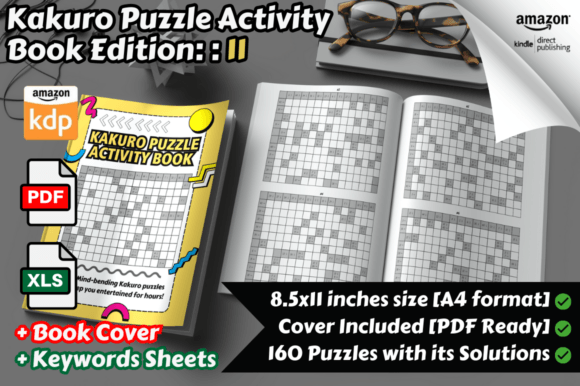
The interior file is formatted at 8.5 by 11 inches, which is standard letter size. That means printing is easy whether you are using a home printer, a local print shop, or preparing the file for a commercial print run. The puzzles are laid out with enough breathing room around each grid that you can jot down notes, pencil in tentative sums, and erase without the page becoming a smudged battlefield. A separate cover file is included, professionally designed to give the finished book a polished presence on a shelf or coffee table.
There is also an Excel spreadsheet packed with relevant keywords, which speaks to a different kind of user entirely. Creators, publishers, and anyone selling puzzle books online will recognize the spreadsheet as a practical marketing asset. It is a thoughtful inclusion that bridges the gap between a consumer product and a creator resource.
Why Different People See This Book Differently
Not everyone approaches a puzzle book with the same expectations. A beginner might crack open Kakuro Puzzles Activity Book Part 06 looking for gentle instruction. An experienced solver might scan the first few pages to gauge whether the difficulty curve offers enough resistance. A teacher might flip through wondering how many puzzles they can photocopy for a classroom warm-up. A small business owner might study the formatting, the layout, and the cover design as market research for their own publishing ideas.
The Beginner's Perspective
If you have never solved a Kakuro puzzle, the grid can look intimidating. Numbers scattered along the edges, blank cells waiting to be filled, and rules that seem simple on paper but demand a shift in how you think about addition. The early puzzles in this volume serve as a quiet onboarding. They do not hold your hand with lengthy tutorials, but they are structured so that the logic reveals itself naturally. By the time you finish the first handful of puzzles, the relationship between sums and possible digit combinations starts to feel intuitive.
Beginners often prioritize ease of use above all else. Is the layout readable? Are the sums clearly indicated? Can you erase and retry without destroying the page? The 8.5 by 11 format helps here. Nothing is cramped, and the solution pages are close enough to reach without flipping through half the book.
The Experienced Solver's Lens
Longtime Kakuro enthusiasts evaluate a puzzle book through a different set of criteria. They look at the quality of the puzzle design. Are the grids logically solvable through deduction alone, or do some require guesswork? Are there interesting patterns that reward strategic thinking? Does the difficulty escalate in a satisfying arc, or does it plateau too early?
Kakuro Puzzles Activity Book Part 06 seems to have been built with these solvers in mind. The 80 puzzles are not randomly generated filler. They are arranged to gradually introduce more complex interdependencies between rows and columns. A seasoned solver might find the first third comfortably familiar, the middle third engagingly tricky, and the final stretch genuinely demanding. The 80 solution pages become less of a crutch and more of a verification tool. You solve, you check, you confirm. The satisfaction is in the process, not just the result.
Educators and Trainers
Teachers, tutors, and cognitive trainers often keep puzzle books on hand for a reason that extends beyond entertainment. Kakuro builds numerical fluency without feeling like a math drill. Students practice addition, decomposition, and logical deduction under the guise of solving a puzzle. The pressure of a timed test disappears. What remains is a quiet, self-paced exercise in reasoning.
For this group, flexibility and reliability matter. The 8.5 by 11 PDF interior means pages can be printed individually. A teacher can select puzzles at an appropriate difficulty level for different students without handing over the entire book. The solution pages provide an answer key that saves time when reviewing student work. An educator does not need to solve every puzzle themselves to verify a student's progress.
Creators, Publishers, and Entrepreneurs
This is where Kakuro Puzzles Activity Book Part 06 takes on a dimension that purely recreational puzzle books rarely explore. The inclusion of a professionally designed cover file, an interior template, and an Excel keyword spreadsheet shifts the value proposition. Someone running a small publishing operation, a print-on-demand store, or a digital product shop can study this book as a reference model. How is the interior structured? What does the cover design communicate? Which keywords are being targeted, and how might they apply to a similar product in a different niche?
For entrepreneurs, the book becomes a case study in commercial value and presentation. It demonstrates what a finished, market-ready puzzle book looks like. The spreadsheet alone can save hours of keyword research for someone new to selling activity books online. The cover file sets a benchmark for visual polish. The interior layout offers a template for spacing, font sizing, and solution formatting. None of this subtracts from the book's primary purpose as a puzzle collection. It simply adds an educational layer for those positioned to notice it.
Families and Social Solvers
Puzzle books rarely get described as social tools, but anyone who has hosted a gathering where smartphones are set aside knows the value of a shared tabletop challenge. Kakuro puzzles invite collaboration. One person suggests a possible digit combination. Another points out a column constraint that rules it out. A third spots the breakthrough that unlocks the rest of the grid.
Family bonding around puzzles works because the activity is inclusive. Younger participants practice arithmetic. Older family members exercise working memory. The difficulty range in this volume means different people can engage with different puzzles at their own level, then come together for the harder ones. The 80-puzzle count provides enough variety to sustain multiple gatherings without repetition.
What Sets This Volume Apart
On the surface, Kakuro Puzzles Activity Book Part 06 is another puzzle book. Look closer and the design decisions accumulate. The one-to-one puzzle-to-solution ratio. The letter-sized format. The separate cover file. The keyword spreadsheet. Each element addresses a specific user need, whether that user is a casual solver, a dedicated enthusiast, a teacher, or a business owner evaluating the puzzle book market.
The learning value extends in two directions. For solvers, it builds logical reasoning and numerical comfort through repeated, progressively challenging practice. For creators, it offers a practical demonstration of how to structure, present, and market a puzzle book. Few products serve both audiences simultaneously without diluting the experience for either. This one manages it by keeping the puzzle content pure and the creator resources clearly delineated as supplementary files.
How to Decide If It Matches Your Goals
Choosing a puzzle book often comes down to a handful of personal priorities. If your primary goal is relaxation with a mental edge, the 80 puzzles provide weeks of gradual, satisfying engagement. If you want portability, the PDF format lets you print pages as needed or load the file onto a tablet for travel. If you are evaluating puzzle book publishing as a potential income stream, the bundled resources offer a head start on understanding the production and marketing side.
Consider your skill level honestly. A complete beginner to Kakuro might spend extra time on the first few puzzles and should not feel discouraged by that. The solutions are there precisely so no one gets stuck indefinitely. An advanced solver might find the opening section a warm-up rather than a challenge, but the back half of the book should deliver the resistance they crave.
Think also about your long-term usefulness needs. Some puzzle books are one-and-done. You solve them, you shelve them, you move on. This volume, with its printable format and reusable digital files, functions differently. A teacher can return to it year after year. A family can reprint favorite puzzles. A publisher can revisit the template and spreadsheet as they develop new products. The value persists beyond a single read-through.
The Quiet Appeal of Kakuro
Kakuro does not shout for attention the way some puzzle formats do. It does not rely on wordplay, trivia, or cultural references that might date it. The digits 1 through 9 are universal. The logic is timeless. A well-constructed Kakuro puzzle from a decade ago is just as satisfying today as it was then. That consistency is part of the genre's enduring appeal, and Kakuro Puzzles Activity Book Part 06 leans into it without trying to reinvent the format. It simply executes well on the fundamentals and adds practical extras that make sense for a digitally distributed puzzle book in the current market.
Whether you are solving for the quiet satisfaction of filling in the final digit, printing a stack of puzzles for a long flight, or studying the product structure for your own creative projects, this volume meets you where you are. The puzzles do not care about your background, your profession, or your reason for opening the book. They simply wait, ready to reward careful thought with that small but genuine burst of accomplishment that keeps puzzlers coming back.