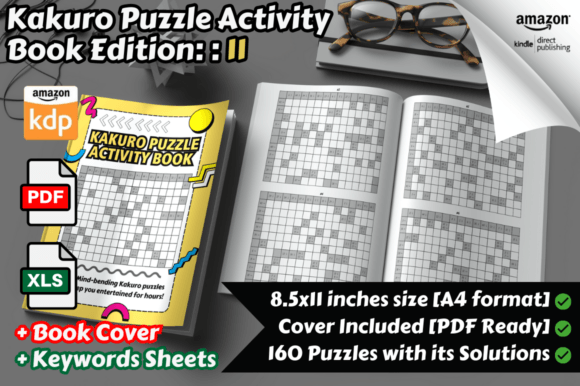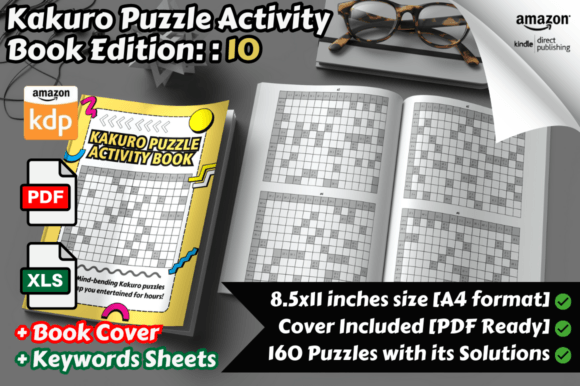
Kakuro Puzzles Activity Book Part 10: Your Next Mental Marathon
There comes a point where crossword puzzles feel too wordy and sudoku starts to repeat itself. That's exactly when Kakuro Puzzles Activity Book Part 10 enters the picture. This isn't just another puzzle collection. It's a carefully structured volume that builds on everything the series has established—80 pages of escalating challenge paired with 80 pages of clear solutions, all wrapped in a professionally designed package that makes printing and solving equally satisfying.
If you've worked through earlier volumes in this series, you already know the rhythm. Part 10 raises the bar without feeling punishing. The puzzles demand more from your number sense, but they never abandon the logic that makes Kakuro so absorbing. For newcomers, there's enough here to learn the ropes, though you might want to keep a pencil with a good eraser nearby.
What Sets This Volume Apart
The Kakuro format itself combines the spatial reasoning of a crossword with the arithmetic constraints of sudoku. You're given a grid with blank cells and clue numbers along the top and left edges. Each clue tells you the sum of the digits in the corresponding row or column. The catch? Digits 1 through 9 can appear only once per sum group. That single rule creates cascading logical deductions that can humble even experienced solvers.
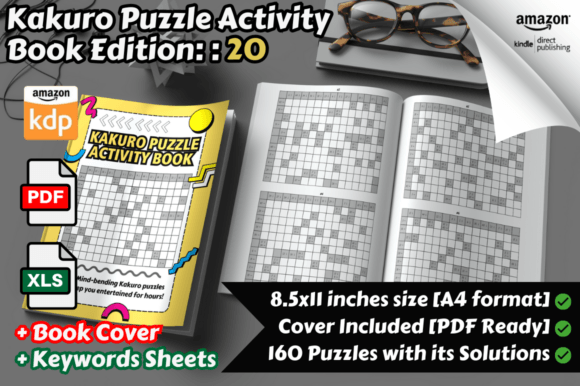
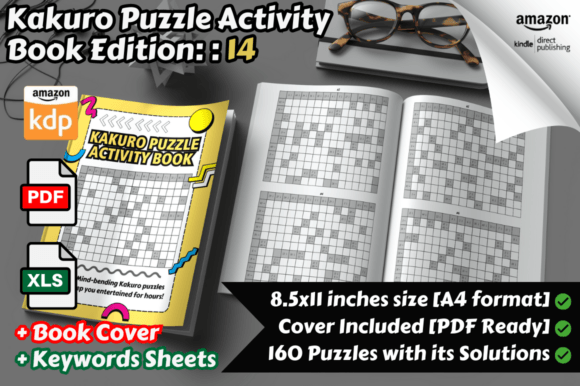
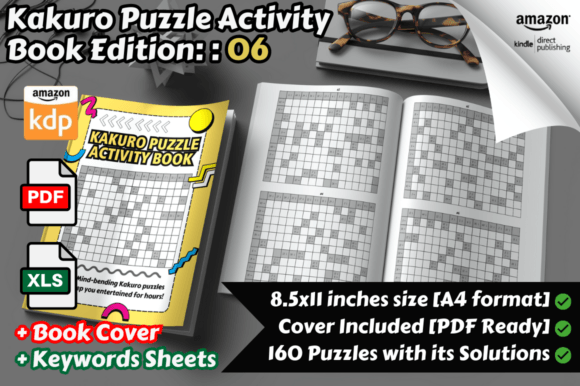
Kakuro Puzzles Activity Book Part 10 distinguishes itself through its internal file design. The 8.5x11-inch PDF interior isn't just a scanned collection of puzzles. Each page is laid out with generous white space around the grids, giving your eyes room to breathe and your pencil room to scribble notes. The clue numbers are crisp and sized correctly—no squinting required, even if you're working from a tablet screen at slightly reduced zoom.
The included Excel spreadsheet deserves a mention because it solves a problem most puzzle book creators ignore. That keyword list isn't marketing fluff; it's a practical tool for anyone who plans to redistribute, resell, or adapt the content. Bloggers, newsletter curators, and activity book publishers can immediately understand how to position this material for their specific audiences.
Why Kakuro Hits Different Than Other Puzzles
Sudoku trains pattern recognition. Crosswords test vocabulary and cultural knowledge. Kakuro demands something else entirely: it forces you to hold multiple arithmetic possibilities in your head while cross-referencing constraints from intersecting rows and columns. You're not just filling cells—you're constantly recalculating which combinations of digits could possibly satisfy two different sums simultaneously.
This dual-constraint thinking translates surprisingly well into professional problem-solving. When a marketer evaluates campaign budgets against channel performance metrics, they're essentially solving a real-world Kakuro. When a project manager balances timeline constraints with resource availability, the mental process mirrors what happens when you stare at a partially filled grid and realize only one digit can go in that stubborn corner cell.
The cognitive benefits aren't abstract. Regular Kakuro solvers report sharper mental arithmetic, improved working memory, and a heightened ability to spot logical inconsistencies quickly. None of this requires grinding through joyless drills. Each puzzle in Kakuro Puzzles Activity Book Part 10 feels like a self-contained mystery rather than an exercise.
Educational Settings That Benefit
Math teachers and tutors have been smuggling Kakuro into their classrooms for years, and Part 10 provides fresh material that hasn't circulated through photocopied worksheets yet. The puzzles reinforce addition skills without the tedium of flash cards. Better yet, they teach students to verify their work constantly—a wrong digit doesn't just break one sum; it creates a domino effect that becomes obvious when the next intersecting sum refuses to resolve.
Homeschooling parents will appreciate the included solutions section. Instead of working through every puzzle ahead of time to create an answer key, they can let students tackle the grids independently and check their own work. The 80-page solution section matches the puzzle section page for page, making verification frictionless.
Content Creators and Publishers
Activity book creators understand the perpetual hunger for fresh puzzle content. Kakuro Puzzles Activity Book Part 10 comes with a professionally designed cover file and interior layout that adapts cleanly to print-on-demand platforms. The 8.5x11-inch format matches the most common activity book trim size, so there's no awkward reformatting required.
For newsletter writers and membership site operators, these puzzles work as lead magnets, subscriber exclusives, or regular feature content. Kakuro has the advantage of being less common than sudoku—your audience is less likely to have already seen a given puzzle before, which increases the perceived value of what you're offering.
Professional Development and Team Building
Workshop facilitators and corporate trainers can adapt puzzles from this volume for warm-up exercises or break activities. Handing out a Kakuro puzzle before a strategic planning session quietly primes participants for the kind of multi-variable thinking the meeting will require. It's subtler than trust falls and considerably more dignified.
Design Choices That Affect Usability
The decision to keep the interior at 8.5x11 inches matters more than it might seem. Smaller puzzle books force cramped grids where pencil marks become illegible. Larger formats feel unwieldy on a lap desk or airplane tray. This trim size hits a sweet spot—substantial enough to accommodate clear numbering, compact enough to toss into a laptop bag alongside your actual work materials.
The PDF format means you're not locked into one solving method. Print enthusiasts can run copies on standard letter paper and fill the grids with their favorite mechanical pencil. Tablet users can import the file into a note-taking app and solve with a stylus, zooming in on tricky sections without losing clarity. The vector-quality design ensures sharp rendering at any magnification.
Who Gets the Most Out of This Volume
Puzzle enthusiasts who've exhausted the kakuro offerings in their local bookstore will find Part 10 a welcome addition. The puzzle count—80 unique grids—provides substantial solving hours without the repetition that plagues some mass-market collections. Each puzzle stands alone, so you can jump to a harder grid when you're feeling sharp or stick with moderate ones during your commute.
Freelancers and remote workers who struggle with the blurry boundary between work and leisure will appreciate how Kakuro creates a clean mental transition. Solving a puzzle occupies your brain just enough to stop the work-related thought loops without demanding the sustained attention that a complex novel or strategy game requires. It's a mental palate cleanser.
Retirees maintaining cognitive fitness gravitate toward puzzle routines, and Kakuro Puzzles Activity Book Part 10 fits neatly into a daily brain-training regimen. The progressive difficulty across the 80 puzzles means there's always a slightly harder challenge waiting, which encourages consistent practice without overwhelming frustration.
What to Consider Before You Get Started
If you've never solved a Kakuro before, expect a learning curve. The rules are simple to state but take time to internalize. You'll spend your first few puzzles constantly referencing the sum possibilities for different clue numbers. Stick with it. By puzzle five or six, you'll start recognizing common combinations instinctively—the 3 that must be 1 and 2, the 4 that breaks into 1 and 3, the 17 in two cells that can only be 8 and 9.
Print quality matters if you're going the paper route. Use a printer with decent resolution and avoid draft mode, which can make the clue numbers slightly fuzzy. The design files are sharp, but your output hardware needs to cooperate to preserve that clarity.
For those planning to use the Excel keyword spreadsheet commercially, spend time customizing the keyword list to your specific niche rather than deploying it as-is. The provided keywords give you a strong foundation; your audience's specific search behaviors should guide any refinements.
Making Kakuro Part of Your Routine
The most successful puzzle habits are the ones that attach to existing routines. Morning coffee and a puzzle. Lunch break and a puzzle. The 15-minute wind-down before sleep and a puzzle. Kakuro Puzzles Activity Book Part 10 fits into these slots because you can make meaningful progress on a grid in 10 to 20 minutes without feeling rushed. Unlike massive crossword puzzles that punish interruption, Kakuro lets you step away and return without losing your place—the numbers you've already placed hold your logical state.
Some solvers photograph their completed grids as a progress log. Others annotate the margins with completion times. However you track your solving journey, the satisfaction of working through all 80 puzzles creates a sense of momentum that generic puzzle apps struggle to replicate. There's something grounding about a finite collection you can physically complete, rather than an endless algorithmic feed of procedurally generated grids.
Whether you're buying for personal enjoyment, sourcing content for a publishing project, or hunting for a gift that won't collect dust on a shelf, this volume earns its place. The puzzles are fair, the design is professional, and the format respects your time and your eyesight. That's more than you can say for most puzzle books that pass through your Amazon recommendations.