Track Every Design with an Architecture Project Book
Most creative work falls apart long before the final draft. Not because the idea was weak, but because the process scattered across sticky notes, loose pages, and forgotten digital files. An Architecture Project Book solves that problem quietly. It gives your thinking a physical home — structured enough to keep you on track, flexible enough to let ideas breathe.
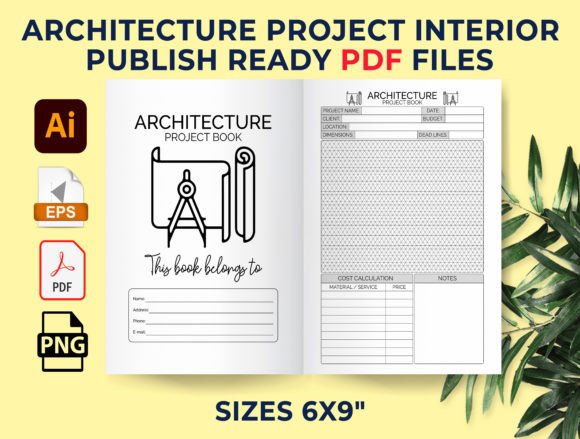
At its simplest, this is a 6" x 9" journal with 120 pages and a per-day format built around simple tracking. But calling it a journal undersells what it actually offers. It's a lightweight project management tool that fits in a bag, a client meeting companion, and a personal archive of decisions made and paths not taken. The 300 DPI high-resolution interior means every page prints crisp and clear, whether you order a single copy or prepare files for KDP publishing. No bleed, no formatting headaches — just clean, ready-to-use spreads.
What Makes a Dedicated Project Book Different
Generic notebooks treat every entry the same. An Architecture Project Book understands that creative work has rhythm. Some days you sketch. Some days you list. Some days you stare at a blank page and need a prompt to re-engage. The per-day format creates gentle structure without forcing a rigid system. You get a consistent starting point each time you open it, which lowers the friction of beginning.
The simple tracking element matters more than it first appears. When a project stretches over weeks or months, it's easy to lose sight of progress. A dedicated space to note what moved forward — even incrementally — builds momentum. That small check-in transforms a notebook from a passive container into an active accountability partner.
And then there's the note space. Not cramped margins where you squeeze thoughts sideways, but intentional room to capture insights, client feedback, material considerations, or the kind of tangential idea that often turns out to be the real breakthrough. The unique design balances all three elements — daily framing, progress tracking, and open reflection — without any one dominating the page.
Who Benefits From an Architecture Project Book
The obvious audience includes architects and designers, but the book's utility stretches far wider. Anyone managing multi-stage creative work can adapt its framework. The 6" x 9" dimensions hit a sweet spot — large enough to write and sketch comfortably, small enough to carry everywhere.
Freelancers and Independent Creators
When you're your own project manager, creative director, and billing department, clarity becomes currency. Use the tracking section to log billable hours or completed milestones. Reserve the notes area for client revisions and scope conversations. Over time, the book becomes a defensible record of what was agreed and when. For KDP publishers and content creators, this is especially valuable — version tracking across multiple titles or product lines stays organized without spreadsheets.
Small Business Owners
Renovations, office layouts, retail space planning — many business owners manage projects that parallel architectural work without having formal training. The per-day format helps break overwhelming undertakings into daily actions. Monday might focus on measurements. Tuesday on material sourcing. Wednesday on contractor conversations. Each gets its own dated entry, and the tracking row shows at a glance whether the week is gaining or losing ground.
Educators and Students
Studio-based learning thrives on iterative feedback. An Architecture Project Book gives students a single repository for critique notes, precedent studies, and evolving design rationale. Later, when portfolios need narrative context, the book supplies it. For educators guiding multiple student projects, a dedicated book per major project keeps observations organized and makes semester-end reviews more substantive.
Hobbyists and Serious Enthusiasts
You don't need a professional license to think architecturally. Home renovation, garden structure planning, even furniture building involve spatial reasoning, material constraints, and phased timelines. The book's no-bleed print-ready format means you can sketch a sight-line study on one page and list lumber dimensions on the next without ink bleeding through. For hobbyist makers who eventually want to share or sell their plans, having clean documentation from day one saves enormous retroactive work.
Creative Applications Beyond the Expected
Calling it an architecture book signals its design roots, but the underlying structure supports many adjacent creative practices. The key is recognizing that "architecture" refers as much to how you build ideas as to buildings themselves.
- Content creators and bloggers can map editorial calendars, track content pillars, and note performance insights — building an information architecture that grows more sophisticated over time.
- Event planners managing venue layouts, vendor timelines, and guest flow find the per-day tracking ideal for the compressed timelines events demand.
- Product designers iterating through prototypes can log test results, user feedback, and revision priorities in a format that mirrors design sprints.
- Marketers developing campaign architectures use the tracking row for metric check-ins while the open notes capture creative briefs and A/B test variants.
- Writers structuring long-form work — novels, courses, serialized content — treat chapters or modules as projects, tracking daily word counts and narrative architecture decisions.
The versatility comes from the book's restraint. It doesn't over-specify. The intro page gives you a moment to define what "project" means in your context, and from there, the format supports whatever definition you bring.
Practical Guidance for Getting the Most Out of It
Even the best tool works only as well as the habits around it. A few grounded approaches help the Architecture Project Book earn its place in your workflow.
Start With a Clear Project Definition
Use the intro page decisively. Write down the project name, core objective, key constraints, and expected timeline. This sounds obvious, but many people skip it and wonder later why their notes feel scattered. That single page anchors everything that follows. When you're deep in details and losing perspective, flipping back to the intro restores context in seconds.
Commit to the Per-Day Rhythm
The format invites daily engagement, but perfection isn't the goal. Even a three-sentence entry on a chaotic day keeps the thread intact. What you're building is a trail of breadcrumbs — enough to reconstruct your thinking when you return after a break. Days you skip aren't failures; they're just gaps that make the tracked entries more meaningful.
Let the Tracking Row Do Its Job
Resist turning the tracking section into a second note area. Keep it brief: a checkmark, a percentage, a word or two. The power of simple tracking is pattern recognition. After two weeks, you'll see which days consistently move work forward and which get consumed by reactive tasks. That's actionable data, not busywork.
Protect the Note Space for Real Reflection
The notes section is where synthesis happens — where you connect a client's offhand comment to a design choice, or realize that three separate problems share a single root cause. Don't fill it with to-do items you'll never revisit. Use it for insights you want to remember in three months. The 300 DPI high resolution print quality matters here because clean, readable pages invite re-reading. Blurry or bleeding pages discourage it.
Why Print-Ready Quality Changes the Experience
Many journals exist only as digital templates or cheaply printed blanks. This Architecture Project Book was designed for print from the start. The 6" x 9" trim size is an industry standard, which means KDP prints it without scaling issues or unexpected margins. The files come in multiple formats — PDF, AI, EPS, and PNG — giving you flexibility whether you're publishing commercially or printing personal copies.
No-bleed design means every element stays comfortably within printable bounds. For anyone who has wrestled with KDP's requirements — or lost important content to trimmed margins — this is a significant practical benefit. The book was tested specifically on KDP, so the error-free guarantee isn't marketing language; it's the result of someone doing the formatting work upfront.
This also makes the book an interesting gift option. A clean, professionally-printed project journal feels substantial. For a colleague starting a new venture, a student entering a design program, or a friend embarking on a renovation, it's a gift that signals you take their ambition seriously.
Adapting the System Over Time
One book handles one project gracefully. But the real insight comes when you complete a project and start another. Comparing two filled books reveals how your process evolves — where you consistently stumble, which phases flow easily, and how your estimation accuracy improves with practice.
Some users adapt the system by color-coding the intro page for different project types or keeping a running index at the back. Since the file includes editable formats, you can add or delete pages to match your workflow. Want a 90-page version for shorter projects? Adjust it. Need extra note pages at the tail end? Insert them. The base structure is sound enough to modify without collapsing into chaos.
The Architecture Project Book doesn't promise creative breakthroughs or guaranteed productivity. What it delivers is rarer: a reliable place to externalize your thinking, track your progress without overhead, and build a personal record of work that actually reflects how you think and create. For architects, designers, entrepreneurs, publishers, and anyone building something from scratch — that quiet reliability is worth more than any feature list can capture.