The Strategic Power of a Well-Designed To-Do List
Most people treat a to-do list as a simple capture tool—a parking lot for half-remembered tasks. They fill it with urgent but unimportant items, then feel a shallow sense of progress as they check off boxes. That approach rarely leads to meaningful results. When used strategically, however, a to-do list becomes a decision-making framework, a creative brief, and a quiet engine for deliberate progress. It can shape how you allocate your highest-leverage hours, align daily work with longer-term goals, and even strengthen your professional brand.
Whether you’re an entrepreneur managing multiple product launches, a marketer juggling campaign deadlines, a freelancer building client relationships, or a publisher designing interiors for Amazon KDP, the principle is the same: the structure and intent behind your list matter far more than the list itself. A thoughtful to-do list is not a collection of obligations—it’s a curated sequence of actions that moves you toward a clear outcome.
Why a To-Do List Should Reflect Strategy, Not Just Memory
We often confuse activity with achievement. A long to-do list can feel productive simply because it looks substantial. But if the items on that list aren’t connected to a strategic goal, you may be busy without moving forward. The real value lies in using your list as a filter: every potential task should earn its place by contributing to a defined priority.
Begin by identifying the one or two outcomes that would make your week or month a success. For a KDP content creator, that might be completing a set of ready-to-upload interiors with consistent formatting. For a small business owner, it might be finalizing a partnership agreement. Once those outcomes are clear, the to-do list becomes a tool for backwards planning. Instead of starting with random tasks, you break down the outcome into precise steps and only then add them to your list. This simple inversion changes everything: you’re no longer reacting to what pops into your mind; you’re acting on what matters most.
This approach also reduces decision fatigue. When your list is built around a strategic core, you don’t waste energy choosing between a dozen equally unimportant tasks each morning. Your to-do list tells you exactly where to direct your focus while your energy is at its peak.
The Silent Cost of a Randomly Assembled To-Do List
Using a to-do list without clear goals carries real risks. The most common trap is the illusion of productivity. Checking off small, low-impact tasks releases dopamine and creates a false sense of accomplishment, making it easier to postpone the harder, higher-value work. Over time, this pattern erodes momentum and delays important projects—whether it’s launching a new product line or refining a client onboarding system.
Another risk is context-switching bleed. An unstructured list often mixes deep work (like designing a vector-based cover template) with shallow tasks (like replying to non-urgent emails). Without separation, you treat them as equals, and your brain pays a switching tax each time you jump from creative execution to administrative trivia. A strategically designed to-do list clusters tasks by cognitive mode or project, preserving mental bandwidth and raising the quality of your output.
Finally, a list that’s never reviewed against long-term goals can gradually drift. Tasks that once served a purpose linger out of habit, quietly consuming time and attention. Regular pruning—asking “Does this action still support my current top priority?”—is an essential discipline. Without that reflection, your to-do list becomes a storage unit for obligations that no longer matter.
When a Simple List Isn’t Enough: The Role of Templates and Structure
For many professionals, a blank notepad or a generic app isn’t the best starting point. A well-designed to-do list template or interior layout can reduce startup friction and embed strategic thinking into your daily practice. This is especially true for creators who produce printable checklists, planners, or KDP interiors for their own customers. A template that segments tasks by priority, project, or time block helps maintain clarity without the need to design a new system from scratch each day.
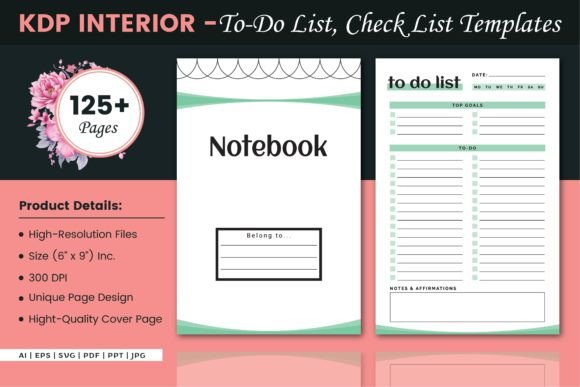
Consider a publisher preparing a 125-page checklist interior for Amazon KDP. The template itself must be clean, reproduction-ready, and thoughtfully organized to guide the end user’s eye. That same design discipline can inform your personal to-do list. When you use a layout that visually separates “must-do” from “nice-to-do” items, or includes dedicated space for notes on today’s primary outcome, you’re more likely to make intentional choices. The structure serves as a silent prompt, reminding you to align tasks with objectives rather than chasing the emotional relief of a completed checkbox.
Even if you’re not designing for KDP, borrowing principles from high-quality interiors—clarity, no-bleed margins, logical grouping—can improve your own planning. A clutter-free, well-organized to-do list reduces cognitive load and makes it easier to scan for the one task that will truly move the needle.
Tailoring Your To-Do List to Your Role and Workflow
Not all work is the same, and a to-do list should reflect that. An entrepreneur overseeing product development, marketing, and customer support needs a different structure than a graphic designer focused on a single client deliverable. The key is to match the list’s format to the nature of the work.
For marketers managing campaigns, a to-do list organized by launch phase—pre-launch, active, post-launch—can prevent tasks from slipping between stages. Each phase has its own mini-list, and you only see what’s relevant right now. Freelancers often benefit from a client-centric layout: one section per active client, with tasks and follow-ups nested underneath. This reduces the mental energy spent reacquainting yourself with a project’s status each time you switch contexts.
Creators building digital assets, such as KDP interior templates in AI, EPS, or SVG formats, might adopt a production-flow list. The sequence follows the asset’s lifecycle: design in Illustrator, export to PDF, test print alignment, prepare the JPG cover mockup, and finally compile the source files for delivery. By mirroring the actual workflow, the to-do list acts as a quality checkpoint as much as a task tracker. You don’t just remember to do something; you remember to verify the output at critical handoff points.
Planning With Intention: Daily Reviews and Weekly Resets
The most strategic to-do list is worthless if you never revisit it with intention. A brief morning review—five minutes or less—can recalibrate your priorities based on overnight changes. Does an urgent client request demand that you postpone a design task? Should you move a high-impact item to the top because a decision you were waiting for just arrived? This daily ritual transforms the list from a static document into a dynamic control panel.
A weekly reset adds the next layer of strategy. Set aside 20 minutes at the end of the week to examine your to-do list through the lens of your larger goals. Which completed items genuinely contributed to your quarterly objectives? Which tasks were merely maintenance? Are there patterns—perhaps you repeatedly delay tasks that involve external communication—that suggest a skill or mindset gap to address? This reflective practice closes the loop between planning and execution, sharpening your judgment over time.
For professionals who ship digital products, this reset can also surface operational insights. Maybe you notice that file conversion tasks (from AI to PDF or PPT) take longer than expected and should be batching differently. Or you realize that customers often ask for a specific format (like an editable SVG) and you could add that to your KDP listing to reduce support queries. The to-do list becomes a source of business intelligence, not just a task repository.
From Personal Tool to Brand Builder: The Public Side of a To-Do List
Your own use of a to-do list might stay private, but the concept has a public dimension for many professionals. Educators use checklists to scaffold student learning. Consultants share task sequences with clients to demystify complex projects. And publishers create printable planners and list interiors that carry their brand identity. In each case, the quality of the list design reflects on your attention to detail and strategic thinking.
If you’re selling a to-do list template as a KDP interior, the experience you deliver influences customer perception. A 6”x9” no-bleed interior with 125 well-organized pages communicates that you understand usability. When you include multiple file types—AI, EPS, PDF, SVG, PPT, JPG—you signal that you value the customer’s preferred workflow. That’s a lesson you can apply to any client-facing material: the structure you provide helps others think more clearly, and that builds trust.
Even if you never sell a product, the clarity you bring to your own planning inevitably shapes your communication with colleagues and clients. A thoughtfully organized to-do list makes you more reliable. You’re less likely to miss deadlines or forget follow-ups because your system has already anticipated those touchpoints. Reliability, in turn, strengthens your professional reputation.
Practical Decision-Making: What to Include, What to Ignore
No to-do list can hold everything. The art of the strategic list lies in omission. A practical approach is to apply a simple test before writing down any task: “If I complete this, will it make the next step on my primary project easier, faster, or significantly better?” If the answer is no, consider whether it belongs on a separate “someday” list or can be delegated.
A related tactic is to assign a time estimate to each task. When you see that a task will take 90 minutes of deep focus, you’re less likely to schedule it between two meetings. For creative work—such as designing an editable source file in vector format—you might block two uninterrupted hours. Your to-do list then doubles as a time-allocation plan. This prevents the common mistake of overfilling a day with good intentions and ending up frustrated.
Also pay attention to dependencies. Sometimes a task can’t start until a decision is made or an asset is available. Mark these items with a symbol that indicates “waiting for input.” That way, your to-do list doesn’t mislead you into thinking you have more actionable work than you actually do. It also prompts you to follow up on stalled dependencies, moving projects forward instead of letting them quietly stall.
Avoiding Burnout: The To-Do List as a Boundary Tool
Many high performers fall into the trap of using a to-do list as a weapon against themselves—always adding, never satisfied. A healthier, more sustainable approach is to treat the list as a boundary tool. Decide in advance how many major tasks you’ll tackle in a day, and stop when you reach that limit. The list should define the finish line, not an endless treadmill.
This is especially important for entrepreneurs and freelancers who lack an external structure. When you work for yourself, the to-do list can become a tyrant if you let it. By intentionally building in a daily “stop point,” you protect time for reflection, learning, and recovery—activities that aren’t tasks but that sustain your long-term effectiveness. A well-designed planner interior might even include space for a “done for the day” marker, a small nudge to honor your limits.
The Long-Term View: How Strategic Lists Shape Your Future
Over months and years, the cumulative effect of a strategically managed to-do list is profound. You direct more energy toward high-leverage activities, build a reputation for thoughtful execution, and generate compound results. The daily habit of aligning tasks with goals rewires your default mindset from reactive to proactive. You stop asking “What do I feel like doing?” and start asking “What action will most decisively move this project toward its intended outcome?”
For creators and publishers, this translates into a portfolio of polished, valuable assets. A KDP interior doesn’t happen by accident; it’s the result of a sequence of design choices, file checks, and production tasks that were intentionally placed on a list and executed. The same logic applies to a marketing campaign, a consultancy engagement, or a product launch. The list is the invisible architecture that turns vision into deliverable.
In the end, a to-do list is not about remembering to buy groceries or send an email. It’s a thinking tool. When used with clarity and purpose, it shapes not just what you do, but who you become as a professional. And that’s worth far more than a checked box.