Why a Well-Designed 2024 Monthly Planner - KDP Interior Can Transform Your Publishing Business
Publishing on Amazon KDP has evolved into something far more nuanced than simply uploading a document and hoping for sales. The market rewards thoughtful preparation, and few products demonstrate this better than a 2024 Monthly Planner - KDP Interior that arrives fully formatted, print-ready, and designed to meet the exacting standards of both the platform and the end user. The appeal is straightforward. Someone purchasing a monthly planner wants clarity, space, and a layout that doesn't fight them. When you can deliver that consistently, you build a reputation. When you can do it without spending weeks on design, you build a business.
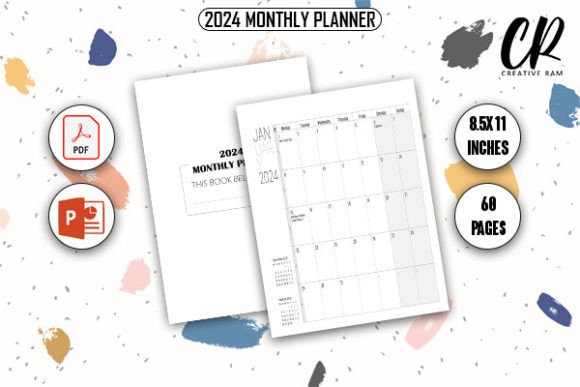
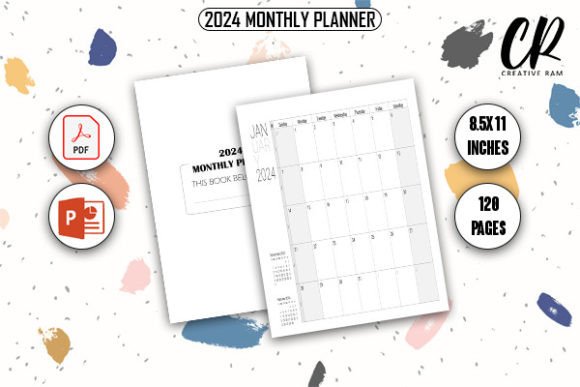
The interior files available for instant download represent a complete package. We aren't talking about a simple grid thrown together in a word processor. This is a 2024 Monthly Planner - KDP Interior spanning 60 pages, set at 8.5 by 11 inches, with bleed included. That bleed matters more than many newcomers realize. Without it, elements intended to reach the edge of the page can leave a white sliver when Amazon trims the final product. The result looks unprofessional. Including bleed from the start signals that someone understood the production pipeline before designing a single page.
What the Package Actually Contains
Let's go through the contents in plain terms. You receive files in two formats: PDF and PPTX. The PDF is the high-quality, print-ready version. You open it, verify everything looks correct, and upload it directly to KDP. No adjustment layers, no font embedding stress, no color profile confusion. The PPTX file serves an entirely different purpose. It exists for customization. Maybe you want to adjust the positioning of a text block, swap out a heading style, or insert a brand-specific element before exporting. PowerPoint handles these tasks with a gentle learning curve, making the file accessible to people who don't live inside Adobe Creative Suite.
The planner includes 12 month planners, one for each month of 2024. Each month also comes with 4 pages of notes. This is a deliberate and practical ratio. Many planners either skimp on note space or overwhelm the user with daily breakdowns they don't need. Four pages per month gives just enough room for goal tracking, habit monitoring, or project notes without bloating the page count unnecessarily. At 60 total pages, the printed product stays reasonably slim, which affects both the perceived value and the printing cost — a factor that directly impacts your royalty calculation on KDP.
Dimensions, Bleed, and Why 8.5″ x 11″ Remains a Smart Choice
The 8.5″ x 11″ format occupies a comfortable middle ground. It is large enough to write in without squinting. It opens flat on a desk and provides generous table space for monthly spreads. It also matches one of the most common trim sizes on Amazon, meaning fewer surprises during the review process. When KDP checks your file against their specifications, a familiar trim size reduces the likelihood of automated rejection due to margin anomalies or scaling issues.
With bleed included, your backgrounds and edge-to-edge elements extend safely past the trim line. If you have ever ordered a book and received a copy where the color stops abruptly a millimeter from the edge, you have seen what missing bleed looks like. A 2024 Monthly Planner - KDP Interior designed with bleed built in eliminates that concern entirely.
Customization Routes With the PPTX Source Files
The inclusion of PPTX source files expands what you can do with this product far beyond a simple reupload. Think about the possibilities. You could launch a series of planners differentiated by subtitle rather than core layout. One version for teachers, another for entrepreneurs, a third for fitness tracking. The internal structure — the monthly grids and note pages — remains identical, but the cover, the "Belongs To" page, and certain interior labels shift to serve each audience. Because PowerPoint allows direct text editing and element manipulation, you can make these changes in minutes rather than commissioning fresh designs each time.
For those who do have design software, having both PPTX and PDF means you can take the bones of the planner and bring it into Illustrator or InDesign if you want deeper control. The PDF serves as a reference for how the print-ready version should look. The PPTX gives you an editable jumping-off point. This dual-format approach acknowledges that your needs might evolve. You might start with zero design experience and later develop the skills to produce more complex variants. The source files don't lock you into a single workflow.
The Often-Overlooked Belongs To Page
A small but meaningful detail is the Belongs To page. It sits at the front of the planner and gives the user a designated spot to write their name, contact information, or a short personal message. From a publishing perspective, this page does something else. It signals intentionality. It says the planner was built as a complete product, not just a collection of calendar grids. When you're competing in a category where many listings look similar, small touches like this influence browsing customers. They flip through the Look Inside preview and see a page that feels personal. That emotional response, however subtle, can tip a purchasing decision.
How Monthly Planners Fit Into Current Buying Behavior
Planners occupy a curious space in the KDP ecosystem. They are not books in the traditional sense, yet they consistently rank among the most popular print-on-demand products. The reason is simple. A planner has a defined useful lifespan. Someone buying a 2024 Monthly Planner - KDP Interior in late 2023 or early 2024 knows exactly what they are getting and why. The purchase feels practical rather than aspirational. It solves an immediate organizational need.
Search behavior reflects this. People don't browse aimlessly for planners. They type specific queries: "2024 monthly planner large print," "monthly planner with notes pages," "12 month undated planner." When your product page matches those terms because your interior genuinely delivers those features, the alignment between search intent and product content strengthens your visibility. Google and Amazon both reward this alignment. The search algorithm doesn't care about marketing language. It cares about whether the listing accurately describes what the interior contains.
Print Quality Considerations for KDP Uploads
A high-quality print ready PDF is not just a nice phrase. It carries specific technical implications. The file should use CMYK color space where applicable, though many KDP interiors are black and white or grayscale. The resolution of embedded elements should meet or exceed 300 DPI at the intended print size. Fonts should be embedded or outlined. Margins should account for the gutter and for the safe zone that KDP recommends. When someone offers a file labeled as print-ready, these factors should already be handled. The 60-page count helps here too. KDP has minimum page requirements for certain paper types. At 60 pages, this planner easily clears those thresholds while keeping printing costs predictable.
Expanding Your Product Line With One Interior
A single interior can support multiple cover variations, and this is where the economics get interesting. You could create five different covers targeting five distinct audiences, all using the same 2024 Monthly Planner - KDP Interior. A watercolor floral cover for a general audience. A dark, minimal cover for professionals. A bright, illustrated cover for students. Each variation becomes its own ASIN on Amazon. Each one draws from a different keyword cluster. You are not creating five planners from scratch. You are creating five storefronts for the same well-built interior.
This approach also lets you test markets efficiently. If one cover style dramatically outperforms the others, you have data. You can double down on that aesthetic in future releases. You can also experiment with title and subtitle combinations, adjusting the metadata to capture different search queries while the physical product remains unchanged. The source files support this agility because you can always go back and tweak elements like the title page or the "Belongs To" page to match a new listing direction.
Thinking Beyond the Calendar Year
The 2024 label on this planner places it in a specific timeframe, but the source files have value that extends beyond a single calendar year. Once you understand the layout logic, you can adapt the structure for undated planners, for 2025 versions, or for evergreen products that don't reference a year at all. The PPTX format makes these date adjustments feasible. Changing month names, updating day grids, and shifting year references are all within the capabilities of basic PowerPoint editing. This means your initial investment in acquiring the interior files continues to pay dividends as you update and re-release products across multiple selling seasons.
Common Mistakes That a Ready-Made Interior Helps You Avoid
Designing a planner from scratch involves dozens of small decisions, and each one represents a potential failure point. Line spacing that looked fine on screen becomes cramped when printed. A font choice that felt elegant turns out to be unreadable at smaller sizes in the note sections. The margin that seemed generous actually violates KDP's requirements when bleeds are factored in. By starting with a 2024 Monthly Planner - KDP Interior that has been designed specifically for KDP publishing, you bypass the trial-and-error phase entirely. The files have already accounted for these variables.
Another common error involves page numbering and section logic. A planner isn't read linearly like a novel, but it still needs internal consistency. The 12 month sections should feel like coherent units. The note pages should appear in predictable positions relative to each monthly spread. When someone flips through the printed result, they should never feel disoriented. Good interior design makes the experience invisible. You don't notice the layout because nothing jars your attention. You just use the planner.
The Role of Note Pages in Perceived Value
Four notes pages per month might seem like a minor detail, but it shapes how the planner gets used. Without note pages, a monthly planner is purely a calendar. With them, it becomes a hybrid tool. Users can record meeting insights alongside their scheduled appointments. They can use the notes section for monthly budgeting, meal planning, or tracking habits. This versatility broadens the appeal. A parent managing a household calendar has different note-taking needs than a freelancer tracking client hours, but both find utility in four blank or lightly structured pages per month. The interior doesn't force a specific use case. It simply provides the space.
What Makes a Print-Ready PDF Truly Ready
The phrase high-quality print ready PDF gets used loosely across many product listings, so let's define what it should mean in practice. The document properties should show the correct trim size set as the page dimensions. Bleed settings should extend artwork by at least 0.125 inches on each applicable edge. Any images or graphical elements should be flattened at the appropriate resolution. There should be no leftover guide layers, no editable text fields that might shift during processing, and no transparent objects that could rasterize unpredictably. When you receive files that genuinely meet these criteria, the upload process to KDP becomes almost anticlimactic. You select your paper type, upload the file, wait for the automated review, and approve the proof. That predictability is worth far more than the cost of the files themselves.
For those new to KDP, this smooth workflow removes a significant barrier to entry. The anxiety around file preparation has stopped many would-be publishers from ever launching their first product. Having a 2024 Monthly Planner - KDP Interior that simply works gives you one less thing to worry about. Your focus shifts entirely to listing optimization, cover design, and marketing — the activities that actually drive sales.
Scalability and Long-Term Thinking
People sometimes view planner interiors as single-use purchases. Buy it once, publish one product, move on. The smarter approach treats them as production assets. A well-constructed interior becomes the foundation for a product line that can generate income across multiple years and dozens of variations. The 60-page count keeps the product affordable to print while substantial enough to feel worthwhile. The PPTX source files ensure you are never locked out of your own product's architecture. Every element remains accessible, editable, and ready to evolve alongside your publishing ambitions.
Ultimately, the market doesn't reward complexity for its own sake. It rewards products that solve real problems clearly and elegantly. A monthly planner helps people manage time. A well-built KDP interior helps you publish that planner faster and with fewer obstacles. The combination of print-ready PDF, editable PPTX source files, thoughtful dimensions with bleed, and a logical internal structure makes this 2024 Monthly Planner - KDP Interior a practical starting point for anyone serious about building a planner-based publishing catalog on Amazon.